Stakeholders across a wide spectrum of industry through education can minimize the occurrence and reduce the severity of combustible dust hazards that are inherent aspect of the manufacturing process. Strategic alliances of user groups, safety councils, OSHA regional offices, and industry leaders are vital in developing a situational proactive awareness in reducing fatalities, injuries, and adverse economic impact caused by combustible dust related fires and explosions.
OSHA Regional Training
MNOSHA (State OSHA Plan) which is part of the Minnesota Department of Labor and Industry consists of separate enforcement and consultation services. Through the Workplace Safety Consultation Division, MNOSHA has already presented two combustible dust training seminars in St. Paul and Cloquet and will be presenting the third seminar, " Preventing Combustible Dust Explosions," seminar November 19, 2008 in St. Cloud, MN. Seating is limited, call 651-284-5060 for additional information.
Currently MNOSHA is working on adopting the Federal OSHA Dust NEP, which is voluntary for the 22 states that have their own separate State OSHA Plan. An excerpt from the Novemeber 2, 2007 Minutes of the Occupational Safety and Health Advisory Council mentions MNOSHA's "Intent to Adopt Identical" combustible dust emphasis program as outlined in the Federal NEP. Hopefully in the future other State OSHA Plan states will follow the example that is being developed in Minnesota. In the meantime MNHA is hosting combustible dust seminars in a strategic alliance with BS&B Pressure Safety Management
User Group Training
Manufacturing and Energy Utility user groups are vital in addressing their membership concerning "best practices." The PRB Coal Users Group is actively addressing the hazards of combustible dust in coal fired energy plants. When referring to the Combustible Dust NEP in Appendix D-1, Industries with More Frequent and/or High Consequence Combustible Dust Explosions/Fires. coal fired energy plants are noted as NAICS 221112, Fossil Fuel Electric Power Generation . The PRB Coal Users Group in conjunction with Power Magazine is offering a Webinar "Combustible Dust: Proactive approaches to managing combustible dust,"
on Tuesday, October 28, 2008 at 10AM Central.
Safety Council Training
The Illinois Safety Council (ISC) has hosted several combustible dust training seminars over the past several months. Working closely with John Newquist, OSHA's Region V Assistant Regional Administrator for State Cooperative Programs and Joe Howicz, CSP and Fire Protection Expert, ISC will host additional training at the University of Illinois October 30, 2008 and November 20, 2008 with the Combustible Dust Explosion Inspection Seminars.
Industry Training
Chilworth Technology, an industry leader in providing process safety services throughout the industry is offering several one-day combustible dust training courses "OSHA Dust Explosion Inspection Preparatory Training," during November and December in Georgia, New Jersey, and Illinois. Chilworth Technology offers a wide range of consulting services in preventing and mitigating combustible dust hazards.
Combustible Dust Policy Institute
It's important that all stakeholders with concerns of combustible dust hazards work together through strategic alliances in addressing the complex issue of combustible dust . The Combustible Dust Policy Institute serves as an informational gateway in providing a situational awareness throughout the manufacturing and utility sectors. Feedback and input is much appreciated and I welcome visitors to the Combustible Dust site in joining the professional combustible dust network on LinkedIn.
The mission of the Combustible Dust Policy Institute is to minimize the severity and reduce the occurrence of combustible dust related fires and explosions in the nation’s workplace. Through ongoing research of combustible dust related incidents, which identifies and evaluates risk, the Combustible Dust Policy Institute provides risk assessment information that a diverse spectrum of stakeholders utilize in effectively controlling combustible dust hazards. Assisting stakeholders in this endeavor, health and safety compliance is achieved in addition to reducing workplace fatalities, injuries, and adverse economic impact.
Sunday, October 26, 2008
Combustible Dust Hazards Training-Strategic Alliances

Tuesday, October 14, 2008
Combustible Dust Hazard Awareness Discussions on LinkedIn

Additionally, the LinkedIn professional network is an ideal venue where we can all communicate effectively between each other concerning a diverse spectrum of combustible dust topics. To join the Combustible Dust Forum you must first sign up on LinkedIn and complete a profile, this eliminates any spammers from interfering and sending unwanted messages.
27 January 2012 Update
The above Combustible Dust Forum was the first combustible dust discussion group on Linkedin. Subsequently, two months later in November 2008, the Combustible Dust Policy Institute also started a discussion group in Linkedin. These are both valuable resources for stakeholders seeking information on combustible dust hazard awareness.
Wednesday, August 20, 2008
Hardboard Plant Dust Fire
A Tuesday evening (8/19/08) combustible dust related fire at a Georgia Pacific hardboard plant in
The manufacturing of hardboard follows under NAICS 321219 (Reconstituted Wood Product Manufacturing), which are manufacturing plants that produce hardboard, particleboard, insulation board, medium-density fiberboard (MDF), waferboard, oriented strand board (OSB), and other panelized products produced from wood chips and particles (combustible particulate solids) CPS.
Since the first of the year, the OSHA IMIS database indicates that 17 inspections have taken place at NAICS 321219 facilities throughout the
Two months ago at a reconstituted wood product facility in Oconomowoc, WI, a combustible dust General Duty Clause citation was issued, which stated :
"where the employer did not furnish a place of employment which were free from recognized hazards that were causing or likely to cause death or serious physical harm, including severe burns, to employees in that workers were exposed to dust explosion, deflagration, or other fire hazards from dust collectors being located inside a building."
Of these recent incidents, injuries have occurred at six percent of the facilities. On a side note, the Chemical Safety Board Dust Hazard Study, revealed that from 1980-2005 in the 281 combustible dust incidents that were found, over 70 percent of the incidents incurred fatalities and injuries. Many who read or hear this data in news reports and congressional testimony are falsely mislead to believe that all combustible dust fires and explosions will result in a 70% fatality and injury rate. This is a far stretch from reality and only deviates from an informative approach in achieving a combustible dust solution to the benefit of the worker and workplace.
Just recently, five days ago a combustible dust related fire flared up at a wood pellet facility in
Friday, August 8, 2008
Paper Mills Exempt From ComDust NEP
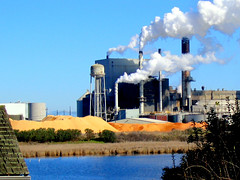
In contrast, with the assistance from local mutual aid, Lincoln Fire Department Fire-fighters subdued the New England blaze after a three hour battle. Luckily no one was injured in both instances, only damaged egos of plant managers and owners. The Longview facility in the Pacific Northwest, sustained an estimated $100,000 in damages according to news reports from the Yakima Herald-Republic.
Inspectors Find No Dust
Less than three weeks prior to the New England paper mill fire, the Federal OSHA Augusta, Maine office cited the facility for electrical, hazardous materials, and exit route hazards. According to news reports from WABI TV, the facility experienced a similar fire months earlier in January 2008. No mention of dust hazards are noted in the online OSHA accident and citation report.
Reviewing OSHA inspection reports for the Longview Fibre paints a revealing picture. Over the past decade Washington OSHA inspectors visited Longview Fibre Washington plants over two dozen times for complaints, referrals, follow-ups, and planned visits. The last citation "serious" was in 11/02/05, for an Ammonia (NH3) infraction. No issues concerning a combustible dust hazard were noted at this facility either.
NAICS Emphasis
The current OSHA Combustible Dust National Emphasis Program (NEP) initially became effective on October 18, 2007 and was reissued March 12, 2008, over a month after the Imperial Sugar Refinery sugar dust explosion. The only difference between the two NEPS, besides the change of the date at the top right hand corner, is that the newer directive divides the NAICS into Appendix D-1 and D-2 with two diverse classifications:
- Industries with More Frequent and/or High Consequence Combustible Dust Explosions/Fires D-1
- Industries that may have Potential for Combustible Dust Explosions/Fires D-2
Amazingly, NAICS 322211/corrugated and solid fiber box manufacturing at Longview Fibre and NAICS: 322121/paper mills at Lincoln Paper & Tissue are not under the OSHA radar as having a combustible dust hazard present at their facilities. Yet combustible dust related incidents can still occur at hundreds of other facilities in the Paper Manufacturing sector without proactive preventative and mitigative measures being addressed in addition to not being listed in the OSHA Combustible Dust NEP.
State Dust NEP Voluntary
The most stunning aspect concerning the OSHA Combustible Dust NEP, is that for states like Washington that have there own OSHA program similar to Cal-OSHA, is that State plan participation in this national emphasis program is strongly encouraged but is not required.
Thats correct, participation is voluntary. The Combustible Dust Policy Institute recently talked with an official from Washington OSHA and it was reaffirmed that the state does not have an emphasis program for combustible dust due to financial resource considerations.
Not If, But When
Combustible dust related fires and explosions will continue throughout the year in the manufacturing sector. At the present rate, the Combustible Dust Policy Institute has projected with approximately 12 incidents/monthly, an additional 50 combustible dust related fires and explosions will occur before years end.
Don't gamble with borrowed time, even if your facility is not a listed NAICS in the OSHA Combustible Dust NEP and generates combustible dust from combustible particulate solids. Perform a process hazard analysis now and have your dust tested for ignition sensitivity and explosion severity immediately as time permits while the sands in the hour glass are dwindling.
Photo Credit: by Jan Tik
OSHA Grain Facility Standard Not Working

If the OSHA grain facility standard is suppose to reduce the prevalence of combustible dust accidents in the grain industry here in the
In contrast, over the past six months with over 70 combustible dust explosions and fires in the manufacturing sector, 22 % have been explosions. Surprisingly, the number of injuries when comparing to combustible dust events between the two industry sectors are approximately the same.
Acceptable Explosions
Recent Senate testimony at a combustible dust hearing by governmental officials have stated that the number of grain facility combustible dust fires and explosions have been reduced since the OSHA Grain Facility Standard was introduced two decades ago. So what is an acceptable number of accidents if combustible grain dust explosions and fires are happening at the same pace as incidents in manufacturing plants?
The only difference between the two is the tragic event at Imperial Sugar, which gained the attention of congressional leaders to take preventative action. It's only a matter a time before the magnitude of the
Take a fast rewind over 3o years ago, to 1977 when several grain silo facilities eerily exploded within days of each other creating a heavy death toll. It was these events that initiated legislation for the OSHA Grain Facility Standard. Earthquakes on the West Coast of high magnitude in metropolitan areas have the same effect. The events are spaced out many years apart but still result in high fatalities, injuries, and extreme economic damage.
Right Idea...Misguided Approach
It's commendable that legislators desire OSHA regulations with protective action to prevent further workplace injuries and fatalities. The problem is with the methodology in achieving this goal. For example, regarding the case with Imperial Sugar and the huge loss of life, concerned legislators were immediately outraged as was the public. Something had to get done and quickly to prevent additional occurrences of accidents of that magnitude. Quick it was, then ensuing congressional testimony began to turn into attacks on OSHA, the director of OSHA, and even the Secretary of Labor.
This is where the problem arose in drafting the Worker Protection Against Combustible Dust Explosion and Fires Act (H.R. 5522). Emotions entered into the picture instead of a reasoned approach which should of consulted all stakeholders concerning life safety, structural integrity, mission continuity, and mitigation of fire and explosions as outlined in the National Fire Protection Association (NFPA) standards.
Jurisdictional Collaboration
Congress needs to reevaluate the stark and unyielding provisions of the pending combustible dust bill, which has all the good intentions of accident prevention and worker safety. Instead the local jurisdictional aspect with collaborative partnerships must be aligned between federal, state, and local entities in the prevention and mitigation of future combustible dust incidents.
Already it is proven the federal provision in the OSHA Grain Facility Standard does not reduce the occurrences of combustible grain dust incidents. How can it? Doesn't take much higher math to figure there are not enough OSHA inspectors to inspect all the grain facilities on a regular basis. Besides it's not up to the federal government to ensure a facility will not go off like a Chinese bottle rocket to the moon at moments notice.
An excellent example of local jurisdictional cooperation with state, local, and federal alliances is Homeland Security. Billions of dollars have gone into that program and millions more too local and state jurisdictions. Is Homeland Security working? Maybe it's too early to tell. But the resources have been spent. Isn't our nations manufacturing sector just as vital or important?
Sunday, August 3, 2008
Ill Advised Combustible Dust Bill

The current combustible dust bill waiting for a vote in the Senate and passed earlier in the House is a faulty draft of proposed OSHA health and safety legislation. Posing as a quick fix with no bite, due to the lack of OSHA resources. Policy- makers failed to take in account the magnitude of the problem with the prevalence of combustible dust fires and explosions occurring across a wide swath of the manufacturing sector.
North America Industrial Classification System (NAICS)
NAICS is a six digit hierarchical industry coding and classification system that the Bureau of Labor and the U.S Census Bureau also utilizes to measure economic activity in the
U.S. NAICS example
- Sector 33 Manufacturing
- Subsector 339 Miscellaneous Manufacturing
- Industry Group 3399 Other Miscellaneous Manufacturing
- Industry 33994 Office Supplies (except Paper) Manufacturing
- U. S. Industry 339941 Pen and Mechanical Pencil Manufacturing
- Industry 33994 Office Supplies (except Paper) Manufacturing
- Industry Group 3399 Other Miscellaneous Manufacturing
- Subsector 339 Miscellaneous Manufacturing
NAICS groups are divided into 20 sectors, with five sectors goods-producing and fifteen services-producing sectors. The NAICS system replaced the older Standard Industrial Classification (SIC) system beginning in 1997. Additionally, there are 474 NAICS industries in the manufacturing sector from a total of 1,170 NAICS industries in contrast to the 1,004 found in the previous SIC.
A confusing aspect of the 2006 Chemical Safety Board, Combustible Dust Hazard Study is that the data spreadsheet referenced combustible dust incidents from 1980-2005 with the old SIC system. For the user of the data, it very difficult to ascertain the specific national industry that experienced combustible dust accidents. In contrast, OSHA began using the North American Industry Classification System (NAICS) for industry identification back in January 2003.
In addition to Appendix D-1, with the listing of 17 manufacturing NAICS in the OSHA NEP, there is Appendix D-2, listing another 50 manufacturing NAICS. OSHA believes these industries may have potential for combustible dust explosions/fires instead of a high frequency rate like in D-1.
Invisible Industries
This is where the problem arises, in solely relying on the OSHA Combustible Dust NEP as a yardstick for whether or not a manufacturing facility has a dust problem or not. The Combustible Dust Policy Institute has discovered through intensive research utilizing media reports and interviews over the past six months that 64% of the 70 combustible dust related explosions and fires since the Imperial Sugar Refinery explosion are not listed in Appendix D-1/D-2 NAICS list of the OSHA Combustible Dust National Emphasis Program (NEP).
Furthermore, of the 16 combustible dust explosions that have occurred, only 50% of the NAICS are listed in the
Saturday, August 2, 2008
Dust Explosions Prior to Senate Hearing
Three days prior to the July 29, 2008 Senate Hearing on workplace Safety, “ Dangerous Dust: Is OSHA Doing Enough to Protect Workers,” ICO Polymers in Asbury, New Jersey witnessed an early morning explosion that severely burned one worker who is in critical condition with burns to his face and arms from the explosion in the plastic pulverizing unit. In the same week four other combustible dust incidents occurred throughout the nation. The cause at ICO Polymers is yet to be determined but all the ingredients are there again for another combustible dust explosion.
Prior Explosions
For instance, one year ago, last July, the same facility experienced a similar event that after an OSHA accident investigation, was deemed a combustible plastic dust explosion in Building One’s Ambient Mill. Where micronized powders of polypropylene, polystyrene, and ethylene were allowed to accumulate, which ignited and exploded, injuring a worker who suffered burns to his hands and back of his head. In this recent incident, New Jersey Fire Officials closed the facility due to the extensive structural damages to the building, which posed an imminent threat.
Recent news reports in the Hunterdon County Democrat, uncovered additional fires at the ICO Polymers facility in 1999 and several explosions in 1997, 1990, and 1989, which also injured workers. In earlier years the plant was owned by Wedco. Change of ownership has not reduced the severity or magnitude of injuries with the events reoccurring in an alarming manner.
Combustible Dust Legislation
A troubling aspect of the recent Senate hearing on combustible dust in conjunction with the recent explosion in
Since the “Worker Protection Against Combustible Dust Explosions and Fires Act of 2008,” was introduced by Congressman George Miller (D-CA) on March 4, 2008 as a result of the February 7, 2008 catastrophic Imperial Sugar Refinery dust explosion in Port Wentworth, Georgia there have been prior hearings held in Congress. Basically, the message has been the same at all the congressional hearings, that there is a problem with the hazards of combustible dust in the nation’s manufacturing sector workplace.
NFPA Combustible Dust Standards
Yet no consensus solutions have been proposed. Instead sole blame has been placed on OSHA which doesn’t have a general industry comprehensive combustible dust standard like the grain facility standard that is already part of OSHA work-place health and safety standards since 1989.
The central aspect of the proposed legislation is incorporating National Fire Protection Association (NFPA) combustible dust standards. This is would be great if OSHA had enough resources to inspect the thousands of manufacturing plants in the nation but it doesn’t. So how will such regulations be enforced unless Congress appropriates additional funding to OSHA? It’s like declaring war yet not sending the troops for lack of funding.
Manufacturing facilities are already required to follow NFPA combustible dust standards through general consensus and nationally recognized standards of care which is recognized by the American National Standards Institute (ANSI). When a violation of combustible dust is found, OSHA inspectors can cite the facility under the General Duty Clause (GDC), Section 5(a)(1) of the Occupational Safety and Health Act.
Local Jurisdiction Enforcement
Local fire and building inspectors that already conduct local inspections need to be utilized more thoroughly in the prevention and mitigation of future combustible dust fires and explosions. These are the professionals that are on the front lines daily and interact daily with local fire departments concerning specific issues that need to be addressed concerning the life safety and structural integrity of commercial buildings.
Fire codes such as the ICC International Fire Code and NFPA Uniform Fire Code already address combustible dust with references to the numerous NFPA combustible dust standards. Following the 2006 Combustible Dust Hazard Investigation, the Chemical Safety Board in addition to recommending an OSHA comprehensive combustible dust standard also outlined that many fire and building inspectors are not knowledgeable concerning combustible dust hazards.
Why hasn’t this aspect of preventing and mitigating future combustible dust incidents been included in congressional testimony? Instead attention has solely been directed at the recent Imperial Sugar incident and placing blame on OSHA as a solution in the policymaking process.
Conclusion
While all the political spin and maneuvering between both political parties concerning labor and business has been taking place over the past five months in regards to pending combustible dust legislation, over 70 combustible dust related fires and explosions have occurred in the nation’s manufacturing sector. The Combustible Dust Policy Institute has discovered through research that approximately 20% of these events are combustible dust explosions and an alarming number are reoccurring like the ICO Polymers accident last week.
A comprehensive combustible dust bill will not solve the problem of combustible dust fires and explosions. It’s only through the cooperation between all stakeholders throughout the national, regional, and local levels that the complex issue of combustible dust can be properly addressed in lessening the severity of future incidents.
Thursday, May 29, 2008
Where: Combustible Dust Explosions/Fires?
Since the February 7, 2008 Imperial Sugar Refinery combustible dust explosion, over 52 reported combustible dust related explosions and fires have occurred in the United States. The majority of incidents are in rural areas where media exposure is limited and a Google Internet search does not provide an accurate number of the actual occurrences in manufacturing facilities.
Overall Picture
A general picture of incidents in the United States is beginning to develop through research conducted by the Combustible Dust Policy Institute in Santa Fe, Texas, utilizing Google Alerts and RSS feeds. When news reports do not include information whether or not an incident is combustible dust related, then a follow-up telephone call acquiring additional information from the local fire investigator or fire chief is conducted to ensure accuracy of the reporting methodology. Once confirmation is achieved then the incident's geographical location is placed on the Google Combustible Dust Incident Map.
Over 75% of the 52 combustible dust explosions and fires have occurred east of the Mississippi. Further distilling the data, along the Atlantic Seaboard states, stretched from Florida to Maine, over 50% of the incidents have happened . Additionally, in the geographical triangle bordered between the Great Lakes, Appalachian Mountains, and the Mississippi River over 30% of the incidents are taking place.
Geographical Hot Spots
Locating geographical hot spots where combustible dust incidents are occurring more frequently will allow all stakeholders to develop proactive measures in preventing future occurrences and at the same time not misdirecting resources where incidents are not happening. Many states do not have a large manufacturing sector that handle combustible particulate solids, so combustible dust fires and explosions are minuscule if not nonexistent problem in these geographical areas.
Time and Space
It's to early to ascertain whether the OSHA Combustible Dust National Emphasis Program (NEP) has any impact on minimizing combustible dust explosions and fires. Currently there is no reduction in combustible dust explosions and fires and at the present rate, an event is taking place nearly every other day somewhere in the United States. Since the Imperial Sugar Refinery catastrophe, injuries have been minimal and it's only a matter of time, space, and luck running out before more fatalities happen.
Voluntary NEP
Much fanfare and hoopla has surrounded the OSHA Combustible Dust NEP, which has really turned into a Trojan horse sort of placebo. The problem is exacerbated at the state level where 22 States have there own OSHA program and not required to have a Combustible Dust NEP, which is voluntary. For example, North Carolina over the past four months is the leading state with six reported combustible dust explosions and fires and at the same time does not have a combustible dust NEP since it has it's own State OSHA program and not federal. Several other State OSHA programs without the voluntary combustible dust NEP's also lead in combustible dust incidents.
Conclusion
The complex issue of combustible dust explosions and fires is more of a regional and geographical problem rather than a national one. It's only when a catastrophic incident occurs with mass fatalities and injuries that a national consciousness arises but this should not be confused with the heart of the problem and that is the geographic nature of manufacturing facilities in the United States. Limited financial resources in the current economy can best be allocated in the specific hot spots and manufacturing sub-sectors where incidents are happening.
A geographical aspect of the complex combustible dust issue needs to be addressed in the upcoming Senate hearing where the combustible dust bill will be voted on prior to arrival on the President's desk. A combustible dust workplace standard definitely needs to be implemented very soon, yet in an intelligent manner that directs regulatory resources efficiently.
Flare-up Combustible Dust Explosions/Fires
Over the past nine days a multitude of combustible dust related explosions and fires have occurred across eight states on both sides of the Mississippi in a myriad of manufacturing industries. Recent incidents include paper, wood, textile, chemical, and plastic manufacturing sectors.
The equipment involved includes a silo, oven, dryer, electrical panel , external burner, auger, and ductwork. Luckily, injuries have been limited to a burn victim in last week's unfortunate wood fiber silo explosion. Prayers still go out to the family and worker for a speedy recovery.
Overall economic damage is in the tens of thousands of dollars. Over 50% of the incidents are reoccurences with combustible dust as the culprit causing a repeat of a dust fire or explosion. For three days last week there was two combustible dust explosions and fires/day, totaling six incidents in three days.
Hopefully after the rash of 14 combustible dust fires and explosions for the month of May, no additional incidents will occur. So lets all cross our fingers for the next two days and pray that the dragon takes a much needed rest. If it keeps up at this pace, 2008 will accumulate a dismal scorecard of over 160 reported combustible dust fires and explosions.
This is in stark contrast to the average of 12 combustible dust explosions and fires/year that the Chemical Safety Board submitted in their Combustible Dust Hazard study with recommendations to OSHA for the period of 1980-2005, which included 281 incidents.
The problem with only acknowledging 281 incidents, is that over 90% of the complex issue concerning combustible dust has not been recognized by industry, governmental regulatory agencies, trade associations, safety professionals, and state/federal legislators. Until all stakeholders recognize and acknowledge that over 3,000 combustible dust explosions and fires have occurred in the past three decades then an understanding of the depth and breadth of the problem will be absent.
In the meantime incidents will occur throughout the nation's manufacturing industries with the explosive atmospheres generated daily in the workplace without precautionary preventative, mitigative, administrative, and technical control procedures.
Thursday, May 22, 2008
Prevalence Combustible Dust Explosions/ Fires
Yesterday on a cool clear quiet morning on the western slopes of the Ozark Plateau the neighborhood in Springdale, Arkansas would soon be aroused by a loud explosion from the wood product plant across the street. Mixing sawdust particles with plastic resins at high temperatures in the manufacturing process can be risky endeavor for any business. Advanced Environmental Recycling Technologies Inc (AERT), is an industry leader in producing products from recycled wood fiber and recycled polyethylene plastic for the construction industry.
Tens of Thousands
Simultaneously spread over several time zones, across the nation’s heartland, tens of thousands of other manufacturing firms would also be conducting there own specialized business handling combustible particulate solids utilizing plastic, rubber, metal, chemical, food, paper, pharmaceutical, and wood feedstock. So who will be dealt a fair hand in getting through the day without a combustible dust fire or explosion occurring at their facility? It’s all a matter of time and space.
While the neighborhood cat was ducking for cover from that pesky mockingbird on Cedar Street, a combustible dust explosion blew the top off the AERT wood fiber storage silo. Just like déjà vu, last year it did the same and flew like a Frisbee 150 foot away. This time, one employee was injured and recent reports indicate he was flown to the Little Rock Burn Center. In the meantime power was knocked out for 1,000 residents and the surge caused power to dim throughout the Springfield Plateau of the Ozarks in northwestern Arkansas.
Not Insurgents
A Hellfire missile fired at insurgents in those deep dark caves faraway in another land that we often hear about in news reports has the same thermobaric effect concerning fuel-air mixtures when dealing with the physics of combustible dust explosions.
Three decades ago, in 1977 over a dozen USDA federal grain inspectors in conjunction with dozens of workers where killed in numerous grain facility dust explosions within a short span of time. Not insurgents or terrorists hiding in caves but our friends, family, and neighbors who we interact with everyday.
As a result of these fatalities OSHA requested that the National Academy of Sciences conduct a study concerning the hazards, ignition sensitivities, and explosive severity of combustible dusts. The results were unanimous and it was recommended in 1984 that all industries should take workplace precautions in preventing and mitigating combustible dust explosions. Instead through much political wrangling a watered down version of an OSHA grain facility emerged and the general industry manufacturing sector was left to fend on their own like an orphaned step-child.
21st Century Awakening
Now in the 21st century combustible dust explosions and fires are still occurring and the recent catastrophic Imperial Sugar Refinery explosion has recently reawakened the need for some sort of workplace protection that was not originally instituted two decades ago when the grain facility standard was implemented.
How serious is the threat of a combustible dust explosion or fire occurring at a local facility? Two years ago the United States Chemical Safety Board conducted a Combustible Dust Hazard study, which uncovered 281 combustible dust fires and explosions from the period of 1980-2005. That’s not much of a threat with an average of less than one accident a month.
In contrast, over the last three months, the Combustible Dust Policy Institute has discovered through media reports and phone interviews with fire chiefs throughout the United States there’s been over 48 combustible dust explosions and fires. Extrapolating this data over the same 25 year period would equate to over 3,000 combustible dust explosions and fires or 2 to 3 accidents a week, like what is occurring now.
The threat of a combustible dust explosions or fires does not seem real as if in some faraway land. Already battle lines have been drawn across political boundaries with Democrat and Republican legislators in the Congress and Senate with the “us against them” mentality and the White House administration has boldly stated that the current combustible dust bill movement will be vetoed.
How soon will another combustible dust explosion on the magnitude of the Imperial Sugar Refinery catastrophe bring all stakeholders together for some sort of solution concerning the current and multi- complex combustible dust issue?
Thursday, May 1, 2008
5 Explosions Leading to Imperial Sugar Catastrophe
The Imperial Sugar Refinery explosion in February 2008 was not an isolated incident of dust explosions in manufacturing industries across the nation's heartland. In the three weeks prior to the Imperial Sugar catastrophe, starting with a quarter moon and ending with a new moon, five combustible dust explosions occurred on both sides of the Mississippi, in the states of Kentucky, Wisconsin, Minnesota, North Dakota, and Virgina resulting in three injuries.
Incidents Continue
Over the last three months since the Imperial Sugar Refinery explosion, the Combustible Dust Policy Institute has recorded 40 additional combustible dust related fires and explosions resulting in injuries and adverse economic damage to local communities.
Millions of workers in over 100,000 manufacturing establishments that process combustible particulate solids are on borrowed time concerning when and where the next combustible dust incident will happen. At the current average rate of one incident every other day, over 100 combustible dust explosions and fires will occur in the remaining eight months of 2008.
Lessen the Odds
Since combustible dusts are an inherent aspect of the manufacturing process theres no absolute method of totally preventing future combustible dust fires and explosions. Bearings will overheat, electrical charges will overcome the dielectric strength of air, and upsets will occur.
To lessen the odds of an incident occurring, preventative administrative and technical measures must be pursued. Additionally, the destructive effects of a dust explosion or fire can be mitigated with explosion ventilation panels, spark detection and suppression systems, in addition to isolation valves. Short term costs for such equipment is initially high yet in the long term valuable assets will be protected from total destruction.
For instance, 40% of the dust explosions that occurred in the three weeks prior to the Imperial Sugar Refinery explosion, had protective and mitigative equipment installed, which lessened the damaging effects of the dust explosion. Additionally, no injuries, fatalities or adverse economic impact occurred in these incidents.
Hazard Assessment
Today is not to late to throughly check all overhead surfaces in the facility for an accumulation of dust. Suspended ceilings that have not been sealed properly can be a deadly culprit in the accumulation of combustible dust, especially if an upset occurs in the plant. The aisles and passageways can be hospital clean. But what about overhead where cleaning and maintenance crews do not usually perform scheduled cleaning duties...sight unseen up above?
May is starting out fresh with no incidents occurring in the last 24 hours. Now the challenge is to get by the rest of the week without a damaging combustible dust fire or explosion occurring. If a facility hasn't done so yet, then now is the time for a hazard assessment of all working areas in the plant.
Are combustible dusts present? If so then find out what potential ignition sources are present. Just like the dust hidden above, hidden electrical charges accumulating and dissipating can be the precursor to combustible dust ignition. Is your process material of high resistivity? If so then now is the time for laboratory testing in determining the minimum ignition energy (MIE) of dusts that are present in the process line.
One Size Fits All?
This week, Congress in a House vote with much opposition, passed a general industry comprehensive combustible dust bill and the next step is a vote in the Senate. The White House with the backing of the Chamber of Commerce has publicly stated their opposition to as they call it, "one size fits all" bill and says President Bush will veto the legislation. How can it be said that this is a "one size fits all"? Especially immediately after the Imperial Sugar incident, 40 combustible dust explosions and fires have occurred in the wood, food, metal, plastic, rubber, chemical, and pharmaceutical industries.
The Combustible Dust Bill is preceding next to the Senate for vote and will insure all manufacturing industries institute preventative and mitigative measures in preventing the devastating effects of predictable future combustible dust related fires and explosions.
Friday, April 25, 2008
Explosion Suppression and Spark Detection
The 2008 Process Technology Expo International Conference to be held at the Donald Stephens Convention Center on the outskirts of Chicago on May 6-8 2008 is the extravaganza to attend concerning combustible dust explosion prevention and mitigation equipment. Exhibitors will be displaying new technologies that the process manufacturing industry utilizes in the prevention and mitigation of future preventable and predictable combustible dust incidents.
Since the tragic Imperial Sugar explosion there's been over 30 combustible dust fires and explosions throughout the United States. OSHA's Combustible Dust National Emphasis Program highlights nearly 70 North American Industrial Classification codes (NAICS) of over 63,000 firms that have frequent and/or high consequence combustible dust explosions/fires in addition to industries that may have potential for combustible dust explosions/fires
The Combustible Dust Policy Institute has localized an additional 47,000 (NAICS) firms that also have occurrences of combustible dust related fires and explosions. With over 110,000 firms potentially exposed to explosive atmospheres in the process manufacturing industries, its' crucial that proactive measures be instituted
Initially firms must conduct a risk analysis of their unique processes in determining if hazards exist. For a minor investment of several thousand dollars, commercial testing facilities can assist in determining the minimum ignition temperature, minimum ignition energy , minimum explosive concentration, and explosive severity of the dust generated in their process.
With the information obtained concerning the ignition sensitivity and explosion severity, plant management can plan on the technical mitigative and preventive measures to implement. Protective and mitigative equipment could include spark detection systems, spark suppression, mechanical isolation valves, explosion vent panels, in conjunction with a multipoint monitoring system.
The PTXi show in Chicago will have a diverse spectrum of combustible dust protection manufacturers exhibiting such equipment and answering technical questions that arise concerning specific applications in the thousands of process industries throughout the nation.
Hope to see you there.
Explosion Protection Resource
(OSHA) Combustible Dust National Emphasis Program (NEP)
2008 Process Technology Expo International Conference
North American Industry Classification System (NAICS)
Thursday, April 24, 2008
Metal Combustible Dust Particle Size
Information in Material Safety Data Sheets concerning fire hazards of most combustible particulate solids and the combustible dusts generated in the manufacturing process is absent in most instances. The definition of a combustible dust as defined by NFPA 654 is:
"Any finely divided solid material that is 420 microns or smaller in diameter (material passing a U.S. No. 40 Standard Sieve) and presents a fire or explosion hazard when dispersed and ignited in air." The same definition is used for combustible metal dust in NFPA 484, Standard for Combustible Metals, Metal Powders, and Metal Dusts.
Additionally, OSHA's Safety and Health Information Bulletin (SHIB), "Combustible Dust in Industry: Preventing and Mitigating the Effects of Fire and Explosions," published in 2005 states:
"That one possible source for information on combustibility is the Material Safety Data Sheet (MSDS) for the material. In some cases, additional information such as test results will be available from chemical manufacturers."
But thats were the problem arises, MSDS's, don't have the vital fire and safety information concerning combustible dust and laboratory testing is very costly. It's highly advised to have testing conducted as soon as possible . Until the facility management completes testing there is one alternative that the Combustible Dust Policy Institute has found most helpful concerning metal combustible dusts in the fabricated metal product manufacturing industries when determining if finely divided solid material is 420 microns or smaller in diameter .
For example, Atlantic Equipment Engineers has provided on their website a metal product technical data reference for over 120 metal powders and compounds. While browsing the numerous metal powders its quite easy in determining the product size of many many powders used in industry. Any US Sieve Series and Tyler Mesh Size higher than 40 would rank the powder as a combustible dust .
For a helpful review of micron powder particle size in relation to mesh size, here is a helpful link:
ESPICorp Inc.
Hope that helps in clarifying particle size in determining if your metal dust is a combustible dust or not. Until then, as soon as possible schedule a testing of your process dust for ignition sensitivity and explosion severity.
Resources:
NFPA 484, Standard for Combustible Metals, Metal Powders, and Metal Dusts
Map Combustible Dust Explosions 2007 & 2006
Here are a few helpful links of Google Maps regarding combustible dust related explosions and fires during 2007 and 2006.The data included in the Google Maps was obtained from Chemical Safety Board incident data. The Combustible Dust Policy Institute did not start collecting incident data until after the Imperial Sugar Refinery dust explosion in February 2008.
Google Map 2007
Google Map 2006
Here at the Combustible Dust Policy Institute, we will continue to provide updated information on the extent of combustible dust incidents throughout the process manufacturing industries. With knowledge of the prevalence of such incidents, all stakeholders can take appropriate preventative measures in protecting life and property.
Tuesday, April 22, 2008
Dozens Combustible Dust Fatalities and Injuries Unaccounted
As H.R. 5522, the Combustible Dust Explosion and Fire Prevention Act bill moves to the House floor shortly, dozens of fatalities and injuries are unaccounted for. Legislators, governmental agencies, and industry trade associations only have a partial picture of the magnitude of the threat posed to the workplace by the hidden dangers of combustible dusts.
Over the past decade 14 documented fatalities and 47 injuries have occurred in two dozen combustible dust explosions and fires that were not included in the official 2006 Chemical Safety Board Combustible Dust Study. Many of the incidents were not cleared for public release due to pending court cases. With the passage of time this information now becomes available to the public through governmental databases.
Chemical Safety Board
The Chemical Safety Board has provided the public with an excellent service considering their limited annual budget of less than $10 million dollars. Most of the workplace accidents consisting of fires and explosions go uninvestigated by the CSB due to limited resources. Innovation combined with computer technology the agency provides helpful feedback to the workplace on root causes of accidents so they don’t occur again. Most helpful to the process industries are the DVD’s that are offered free of charge which are excellent safety training tools for veterans and newcomers to the industry.
As a federal independent investigative agency, the CSB is limited in breath and depth while conducting research on past incidents. Especially troublesome is the absence of central database with records of workplace accidents consisting of fires and explosions. Concerning the Combustible Dust Hazard Study, the CSB did not represent the data as complete or error-free. Especially since the combustible dust incidents were only a small sampling.
Recent Studies
Over the past two months, the Combustible Dust Policy Institute has completed cursory research on combustible dust explosions and fires and picked up were the CSB combustible dust studies ended. Over that past ten weeks since the Imperial Sugar Refinery explosion there have been over 30 combustible dusts related fires and explosions.
Hundreds of Incidents
Currently, many stakeholders both opponents and proponents of the proposed Combustible Dust Explosion and Fire Prevention Act, H.R. 5522, are under the assumption that there has been approximately 350 combustible dust fires and explosions since 1980. This is a very small sampling and a closer number would be approximately 3500 combustible dust explosions and fires over the last 28 years.
Either the earth, moon, sun, and planets were aligned in some unusual manner for the nearly three dozen combustible dust incidents to occur over the past ten weeks or now we have a better picture of the extent of the complex subject of combustible dust incidents occurring in the nation’s manufacturing process industries.
Resources
OSHA Integrated Management Information System databaseFriday, April 18, 2008
63,000 Firms Under OSHA ComDust Program
OSHA's Combustible Dust National Emphasis Program includes over 63,000 firms across a wide spectrum of industries. If all the firms were to be inspected in a one year period then that would equate to 200 inspections daily in determining if a combustible dust hazard exists. This would be impossible with OSHA's limited resources . Additionally, the magnitude of the problem increases with the number of establishments the individual firm has. So one must take into account the number of facilities to increase by 20-30 % from the amount of establishments a firm has.
The Combustible Dust Policy Institute recently completed a study, using the data from the 300 incidents compiled from the Chemical Safety Board combustible dust study. The findings were revealing utilizing U.S. Census Bureau data that was obtained from North American Industrial Classification System records. For instance, an additional 66 manufacturing industries that have a history of combustible dust explosions and fires that OSHA has ignored and is not listed in the Combustible Dust National Emphasis Program. This would conservatively add another 50,000 firms that are exposed to potentially hazardous combustible dust.
With over 113,000 firms in process manufacturing that potentially generate combustible dust explosive atmospheres it is quite clear that voluntary compliance and waiting on the arrival of an OSHA inspector is out of the question. Since the Imperial Sugar refinery explosion in February there has been over 30 combustible dust related fires and explosions.
Either the planets, moon ,and sun had to be in perfect alignment for such a high number of incidents or all of a sudden combustible dust explosions occurred due to pure coincidence. Either way, the 281 combustible dust incidents that the Chemical Safety Board compiled is only a small sample from the period 1980-2005.
A more reasonable number of combustible dusts incidents extrapolating the current 30 incidents would be over 3,000 combustible incidents over the past three decades. During the course of future pending legislation concerning the Combustible Dust Explosion and Fire Act, the Combustible Dust Policy Institute will be completing additional studies in determining the breadth of this complex issue.


 RSS Feed Subscribe