
A new year is upon us. Will we learn from the past? Through media accounts, the Combustible Dust Policy Institute researched over 200+ combustible dust related fires and explosions that occurred in 2008 in the grain, manufacturing, non-manufacturing, and utility sectors. Good housekeeping is a partial solution in preventing and mitigating incidents, especially in regards to secondary explosions, but only one aspect of a multi-dimensional complex subject concerning combustible dust hazards.
For instance, utilizing good engineering practices (GEP) as outlined in the NFPA Combustible Dust Standards would assist in lessening the likelihood and reducing the severity of many incidents that occurred in 2008. Additionally, administrative controls such as hot work permits, inspection, maintenance, and employee/contractor training of combustible dust hazard awareness would proactively provide enhanced measures cost effectively.
The recent grain facility dust explosion in Arizona is a wake up call that dust explosions are prevalent across all sectors. Combustible dust related fires and explosions is an inherent throughout industry. It's only through mitigative and preventative measures that potential fatalities, injuries, and adverse impact will be lessened.

The Combustible Dust Policy Institute proposes an alternate solution addressing the entire spectrum of combustible particulate solids that generate combustible dust across all sectors. Instead of haphazardly piecing together costly regulations singling out individual occupational sectors. Legislators must be educated that all explosions transform energy into blast waves (overpressure), thermal radiation, and ensuing projectiles. It doesn't matter if its runaway reaction explosion, condensed phase explosion, vapor cloud explosion, or dust explosion.
NFPA 654, "Standard for the Prevention of Fires and Dust Explosions from the Manufacturing, Processing, and Handling of Combustible Particulate Solids," has already provided a good start in considering a regulatory framework with mention of a process hazard analysis as already implemented at refineries with the OSHA process safety management (PSM) program. For instance. 29 CFR 1910.119 is intended to prevent or minimize the consequences of a catastrophic explosion from a process.
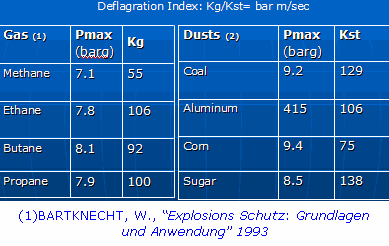
What about combustible dust explosions in other occupational sectors that are of high consequence like the catastrophic Imperial Sugar Refinery explosion earlier last year and now this past week the Arizona Grain explosion that sent three workers with burn injuries to the hospital ? Scientific data compiled from laboratory combustible dust testing has proven that the devastating blast waves and thermal radiation from dust explosions are just as devastating as a vapor cloud explosions.
The learning curve is now complete concerning the hazards of combustible dust in the workplace. All stakeholders must cohesively work together with local, state, and national governmental leaders in developing a comprehensive combustible dust occupational safety framework that ensures the safety of all workers in explosive high consequence occupations.
For additional information on identifying, evaluating, and controlling the hazards of combustible dust related fires and explosions, the Combustible Dust Policy Institute in conjunction with the 4th Annual Industrial Fire, Safety, and Security Conference -IFSS 2009 will be hosting a Two Day Combustible Dust Hazard Workshop at the Reliant Center(next to the Astrodome), February 3-4, 2009, in Houston Texas.
Concerned stakeholders will acquire important information during Day One of the workshop that can be utilized in preventing and mitigating future incidents in addition to understanding the necessary steps in achieving regulatory compliance concerning the OSHA Combustible Dust National Emphasis Program.
Currently a situational awareness is lacking nationwide that combustible dust also poses a potential explosive atmosphere in the same light as flammable gases, vapors, and mists. Instead of vapor cloud or BLEVE explosions that occur in the refining sector there are deflagrations and dust explosions in the manufacturing sector.
Day Two of the workshop will include fire-fighting suppression techniques, equipment, and training resources that are currently available. In addition to active participation through panel discussions, Fire Chiefs from around the nation that respond to combustible dust incidents will share successful fire-fighting tactics in combating combustible dust fires.
WHO ATTENDS IFSS Workshops and Seminars?
Attendees from across the United States converge at IFSS every year to meet with their peers - industrial emergency response and security leaders throughout the industrial and energy marketplace.
INDUSTRIAL FIRE, SAFETY & SECURITY Attendees Include:
FEDERAL/STATE/
MUNICIPAL
* Regulatory Agencies
* Emergency Management Departments
* LEPC's - Local Emergency Planning Committees
* Municipal Fire Districts - Mutual Aid
OPERATORS/INDUSTRY
* Oil & Gas Exploration & Production
* Refineries
* Petrochemical/Chemical Facilities
* Pipelines
* Terminals/Storage Facilities
* Power Plants
* LNG Facilities
* Process Industries
* Transportation/Shipping/Rail
* Emergency Response Teams
* Industrial Fire Brigades
* Security
Preparing for Tomorrow’s Emergencies in Today’s World.
EH&S. Hazmat. Fire. Security. Rescue. Safety. Medical.
Whatever aspect of emergency management you work in, IFSS is the essential destination for staying ahead of the curve – and getting that edge that can make all the difference in your next situation.
IFSS delivers an unsurpassed learning experience!
* Learn about best practices for all types of incidents from industry leaders and technical experts.
* Get three days of answers to your most pressing questions.
* Discover the most innovative products and services at a one-of-a-kind exhibition.
* Hear about valuable “lessons learned” from true-life situations.
* Connect with your peers from around the country.
IFSS is only four days… but the value it provides will pay off all year-long. You will take-away intel, insights and info that will help you on an ongoing basis as you protect America's industrial plant facilities, personnel, energy infrastructure, and critical assets against all hazards.
IFSS 2009 Conference Contacts
Phone: (832) 242-1969
Fax: (832) 242-1971
# # #
The goal of Combustible Dust Policy Institute is to minimize the severity and reduce the occurrence of combustible dust related fires and explosions in the global workplace. Through ongoing exchange of best practices and lessons learned of combustible dust related incidents, which identifies and evaluates risk, the Institute shares risk assessment information that a diverse spectrum of members utilize in effectively controlling combustible dust hazards. Assisting stakeholders in this endeavor, health and safety compliance is effectively achieved in addition to reducing preventable workplace fatalities, injuries, and adverse economic impact. Contact John Astad, Chairperson :Combustible Dust Hazard Workshop@ 409-440-7185


 RSS Feed Subscribe