Its a bit odd and bewildering how data of combustible dust explosions in the Chemical Safety Board, Combustible Dust Hazard Investigation Report that was submitted to OSHA in November 2006 did not include the fatalities and injuries such as the incident that occurred at a Reconstituted Wood Product Manufacturing plant in Mount Jewett, PA back in February 2001. How can appropiate layers of protection be implemented in the workplace if stakeholders do not know the probability and severity of occurrences if full transparency of the complex combustible dust issue is not adhered to?
Incident # 190, which occurred 2/14/2001, is listed in the CSB Dust Incident Data File. But the description is omitted with the statement, "Information not cleared for public release. " How can that be, with the vital information not cleared, when adjacent to the date of the incident is the OSHA Activity Number which provides a description of the above incident and many others labeled "not cleared for public release."?
OSHA has been citing facilities for combustible dust hazards many years prior to the series of catastrophic dust explosions that occurred in 2003. These citations referenced the NFPA Combustible Dust Standards utilizing the General Duty Clause. OSHA through national consensus continues to cite facilities for combustible dust hazards with the power of the General Duty Clause.
Subsequently, OSHA needs to thoroughly review CSB's helpful recommendations in addition to instituting other layers of protection that will provide sufficient preventative and mitigative measures for the workplace in regards to combustible dust hazards. It shouldn't take an Act of Congress with the reissued combustible dust bill to get the ball rolling. Hopefully with the new administration and appointees within OSHA's leadership structure the entire combustible dust issue will be reevaluated in proper context.
The first step must be revising the Combustible Dust NEP so as to reflect the reality of the majority of incidents (over 60%) occuring in national industries (NAICS) not listed in the NEP. OSHA Region 4 has set an excellent example inspecting facilities for dust hazards that are not listed in the Dust NEP. A good rule of thumb would be if a facility has a dust collector on the premises, then there is a potential for a combustible dust related explosion or fire. Think of a dust collector as a hand grenade with the pin pulled and all that is needed next is an ignition source when the lever is released. That just might get everyone's attention with this sort of proactive attitude.
No matter how stringent OSHA enforcement and inspection activities are pursued, combustible dust explosions and fires will continue to occur. Legislators who drafted the current reissued combustible dust bill have all the great intentions in preventing further fatalities and injuries as occurred at Imperial Sugar Refinery last year. But the reality which they must be educated to understand is that dust explosions and fires cannot be totally prevented. Only the probability and severity can be reduced.
A good example is the ethanol plant explosion earlier this month in Hastings, Nebraska with the grain grinder explosion resulting in two injuries. Ethanol plants have the most stringent governmental regulations protecting the worker, public ,and environment with the EPA Risk Management Program (RMP), OSHA Process Safety Management Standard (PSM), in addition to the OSHA Grain Facility Standard. It doesn't get any more stringent than this. The current combustible dust bill as written won't even come close to providing this much of protection. Ironically, with all the layers of protection in this industry, it has the highest rate of explosions and fires over the past twelve months than any of the other 426 national industries (NAICS) in the manufacturing sector.
The current position that legislators and the CSB of possible protective measures is a great start. But should not be the sole solution, especially when other important aspects of the very complex and dynamic combustible dust hazard issue is not also addressed to the full extent. Hopefully insight from continued in-depth research on combustible dust related fires and explosions that the Combustible Dust Policy Institute is conducting will provide additional helpful information on a broad horizon useful to all stakeholders.
Wednesday, March 18, 2009
Dust Explosions-Not Cleared For Public Release

Monday, March 16, 2009
OSHA Region 4 Tough on Combustible Dust

In less than a week several OSHA Regional New Releases issued from the OSHA Region 4 main office in Atlanta, Georgia provided details concerning three establishments, proposing over $400,000 in penalties for safety and health violations, which includes combustible dust hazard violations. Each company has 15 business days from receipt of the citations to comply, request an informal conference with OSHA's area director or contest the citations and proposed penalties before the independent Occupational Safety and Health Review Commission.
OSHA Region 4 includes the states of Alabama , Florida, Georgia, Kentucky, Mississippi, North Carolina, South Carolina, and Tennessee. The numerous citations came from the manufacturing sectors of wood, food, and transportation equipment. Of special interest was the national industry NAICS 336360 Motor Vehicle Seating and Interior Trim Manufacturing, which is not included in the OSHA Combustible Dust NEP as an at risk industry, yet the Georgia facility was cited for using high pressure compressed air to clean equipment resulting in clouds of resin dust, and a second repeat violation for exposing employees to high concentrations of airborne particulates.
Reviewing details of OSHA inspections conducted at manufacturing facilities in Region 4 brings to light that OSHA inspectors are conducting combustible dust inspection and enforcement activities at many other facilities with NAICS not listed in Appendix D-1 and D-2 of the OSHA Combustible Dust NEP. This enhanced enforcement activity concerning combustible dust hazards in the workplace illustrates that all manufacturing and non-manufacturing facilities that handle combustible particulate solids that generate combustible dust must proactively address dust hazards with preventative administrative and engineering control measures.
Resources:
NAICS 321113 D-1 NEP Sawmills
NAICS 311312 D-1 NEP Cane Sugar Refining
NAICS 336360 Non-NEP Motor Vehicle Seating and Interior Trim Mfg.
Saturday, March 7, 2009
Ethanol Plant Dust Explosions and Fires
Like a small tremor on the San Andreas fault line of the West Coast as a precursor to the big one, the recent explosion at the ethanol plant in Hastings, Nebraska provides a similar warning. In less than a year over a dozen combustible dust related fires and explosions have occurred at ethanol facilities throughout the Midwest. The importance of donning proper PPE such as flame resistant clothing (FRC) in such a work environment takes on added dimension with now learning the workers T-shirts were set on fire from the blast. A week prior to the Hastings explosion, according to media accounts, an ethanol plant in Casselton, North Dakota experienced a minor fire in the dust collection bin.
Ethanol plants have complex explosion and fire hazards not found in other manufacturing national industries (NAICS) where the attributes of a grain handling facility is combined with a chemical plant in the production of ethyl alcohol. Subsequently, these process facilities must follow stringent regulatory guidelines according to the OSHA Process Safety Management Standard (PSM) and EPA Risk Management Program (RMP). Additionally, combustible dust hazards are addressed in the OSHA Grain Facility Standard.
With the multitude of regulatory control measures protecting workers, the environment, and the public; accidents still happen. The question arises can the current high incident rate be minimized? In less than a year six ethanol plant explosions have occurred in Michigan, Arizona Minnesota, Kansas, Wisconsin, and Nebraska with ensuing injuries in 50% of these incidents.
So what is an unacceptable accident and injury rate before stakeholders reassess current administrative and best engineering control measures? All the proper administrative and best engineering control measures seem to be in place in the prevention and mitigation of fires and explosions. Yet the incidents are exponentially higher than any other national industry(NAICS) in the manufacturing sector. Hazard awareness through a multitude of educational programs is an excellent measure in addressing this issue.
For instance, ethanol trade associations such as the Renewable Fuel Association (RFA) has an proactive safety program addressing many of the hazards in ethanol production. Additionally, the RFA works collectively with the University of Illinois Fire Service in providing industry with educational programs that prevent future incidents.
Recently, Kirkwood Community College in Cedar Rapids, Iowa was awarded a $174,978 OSHA Susan Harwood Training Grant in hosting a 2 ½-hour awareness-level combustible dust safety course addressing grain dust and other organic dusts such as sugar, flour and paper. The training will provide 150 courses in 14 Midwestern states for 3,000 employers and employees primarily in the agriculture, food processing and fiber sectors with a focus on grain elevators and ethanol bio-refineries. Training is a great administrative approach in providing hazard awareness. But what about the current best engineering control measures and are they adequate?
With the current progression of incidents, this unique national industry with a primary NAICS 325193 Ethyl Alcohol Manufacturing and secondary NAICS 311211 Wet Corn Milling is quite similiar to tectonic plates shifting, one upon the other, and its only a matter of time before another event occurs in the seismic proportion of the 2007 Steamboat, Iowa explosion, causing millions of dollars in damage in addition to potential fatalities and injuries.
Overall, in the majority of these recent ethanol plant incidents, life safety, structural integrity and mission continuity objectives of the NFPA combustible dust standards have been maintained. This is an excellent example illustrating that combustible dust related explosions cannot be totally prevented only the severity reduced. The task now is to somehow reduce the probability.
This overview is not meant to place blame on the ethanol industry which is actively striving to reduce incident rates. Hopefully the information from tracking and researching these incidents will provide stakeholders an enhanced awareness concerning trends that have been developing. With this information possible preventative and mitigative strategies can be devised in minimizing the occurrence of another tremor.
Resources:
Incident Google Map
RMP Facilities
Dry Mill Ethanol Industry .pdf
ETHANOL DRY MILLING: MODEL DESCRIPTION
Feed and Grain Products .pdf
.
Tuesday, March 3, 2009
2008 Dust Explosions and Fires Overview

The Combustible Dust Policy Institute found through researching media accounts in 2008 that over 150+ combustible dust related fires and explosions occurred in the manufacturing, non-manufacturing and utility sectors in the
The current OSHA Combustible Dust National Emphasis Program (NEP) directive does not address the majority of national industries (NAICS) where incidents are frequently occurring. For example, over 60% of incidents in 2008 occurred in national industries not listed in Appendix D-1 and D-2 of the
To further complicate the situation, the Chemical Safety Board Combustible Dust Hazard Study did not include in the profile of affected industries, the Paper, Textile, and Non-Manufacturing subsectors as industries where a combustible dust hazard exists. For
In contrast, over 7% of incidents in 2008 occurred in the rubber/plastics subsector, where these national industries were referenced 90% of the time in the OSHA Dust

For 2008, media accounts of combustible dust related fires and explosions occurred in thirty-six states. The states with 10 more or more incidents included
Reviewing the the grain sector, through media accounts, over 50 combustible dust related fires and explosions occurred in 2008 with over 30% (15) were dust explosions. The adverse economic impact from dust explosions in this sector was much greater than the economic impact from explosions in the manufacturing sector. A question does arise if it makes good sense to model the current pending combustible dust legislation after the OSHA Grain Facility Standard, when so many injuries and economic damage is occurring from dust explosions similar to what’s happening in the manufacturing sector?
This brief overview of combustible dust related incidents in 2008 will hopefully provide all stakeholders additional insight into the complexity of combustible dust hazards in the workplace. The current occupational health and safety regulatory framework does not currently address the magnitude of the problem that encompasses all the national industries where incidents are repeatedly occurring throughout the manufacturing and non-manufacturing sector.
Monday, February 9, 2009
Innovative Dust Explosion Prevention Technology

Back in the 3rd Century B.C, around the same period that the Carthaginian general Hannibal made his epic crossing of the Alps from Spain to Italy atop war elephants, another great feat was accomplished with Archimedes invention of the screw pump or Archimedean screw.
This same invention, after surviving over 2,300 years of applications is still used today in industrial facilities moving bulk solids throughout the manufacturing process. Yet an even greater and more impossible task than Hannibal’s crossing of the Alps is attempting to minimize the generation of combustible dust during the manufacturing process, which creates a potentially explosive atmosphere when concentrations of dust reach explosive limits of minimum explosive concentrations (MEC)
Throughout 2008, over 200 combustible dust related fires and explosion occurred in the manufacturing, non-manufacturing, grain, and utility sectors. Many of these incidents occurred in the transport process; where bucket elevators, screw elevators, pneumatic conveyors and inclined belt conveyors where in the process of conveying particulate solids (bulk solids), that generated combustible dust.
Like Hannibal’s famous quotation, "We will either find a way, or make one.” Eventually sometime in the process, combustible dust will either find an ignition source or make one, such as through an electrostatic discharge to initiate a deflagration. This is where explosion prevention and mitigation best engineering practices comes into the story with reducing the probability of occurrence and minimizing the severity of ensuing combustible dust related fires and explosions.
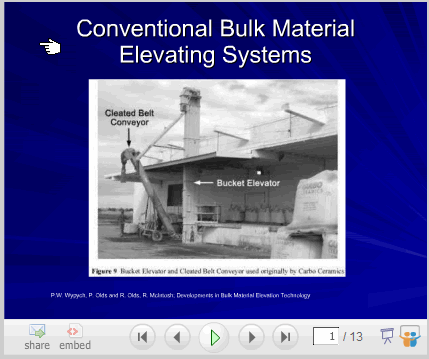
Click to View PowerPoint Slides
But suppose explosion prevention could inherently be designed into the process that transports bulk solids? Instead of, as now is the case, having a more costly explosion prevention engineering control measure, separate from the transport process.
It’s been a tough battle for all stakeholders in minimizing combustible dust hazards in the workplace. Along the way dust explosions and flash fires at subsonic speed continue to occur frequently in industrial settings causing hundreds of fatalities, injuries and adverse economic damage.
A monumental victory in preventing combustible dust explosions occurred in 2003, when inventor Peter Olds, an Australian, from Maryborough in Queensland developed the Vertical Bulk Material Conveyor Olds Elevator in his foundry as an alternative to an inclined screw conveyor. Which at the same time with its full-bore natural choke concept by inherent design isolates ignition and oxygen sources from completing the troublesome fire triangle and ensuing dust explosion.
Additional potential solutions in preventing and mitigating combustible dust related fires and explosion can be found through resources around the world with our global trading partners. Stakeholders in the United States are fortunate that Richard McIntosh
Facility owners and managers are even more aware of the hazards of combustible dust with the reintroduction of the combustible dust bill, which was initated last year following the catastrophic Imperial Sugar Refinery sugar dust explosion. To minimize the generation of combustible dust and at the same time prevent combustible dust explosions as bulks solids are conveyed, an innovative solution with the Olds Elevator is an effective and cost efficient solution. Contact Olds Elevator today for additional information on how the combustible dust hazards of your process stream can be minimized with utilization of the full-bore natural choke technology of the Olds Elevator.
Resources
Developments in Bulk Material Elevation Technology
Preventing Grain Dust Explosions
Saturday, February 7, 2009
Upside Down Combustible Dust Bill

Dust explosions garnered national attention this week with the catastrophic coal dust explosion at a Wisconsin coal-fired electrical energy plant in conjunction with the reintroduction of the combustible dust bill. While it is undisputed that worker protection is needed concerning combustible particulate solids that generate combustible dust in the manufacturing, non-manufacturing, and grain sectors. A question arises in the protective measures outlined in H.R. 849, “The Worker Protection Against Combustible Dust Explosions and Fires Act,” requiring the U.S. Occupational Safety and Health Administration (OSHA) to issue rules regulating combustible industrial dusts.
Stakeholders throughout the industrial sectors including the public must realize that dust explosions can never be totally prevented unless we completely shut down our manufacturing base and turn into a service based economy. For instance, we can learn from our New Zealand trading partner, where proactive dust explosion control measures are in place in protecting local and export industries.
Since instituting these control measures the amount of dust explosions have been constant as previously occurred without control measures. The only difference is the severity of these incidents have been reduced with measures like explosion venting and deflagration suppression best engineering practices.
Propagating Explosions
Combustible dust explosions follow under the subheading of propagating explosions quite similar to vapor cloud explosions in the refinery and petrochemicals sector where a combustion zone propagates at subsonic speeds wrecking havoc with the damaging effects of overpressure, thermal radiation, and ensuing projectiles. In March 2005, the catastrophic BP Texas City Refinery explosion is an example of a propagating vapor cloud explosion with similar damaging effects like the Imperial Sugar Refinery propagating dust explosion in February 2008.
Developing worker protection legislation in regards to combustible dust explosions as written in the current reintroduced bill fails to take into account many important aspects in providing basic layers of protection for the nation’s workforce. Additionally, solely utilizing the Chemical Safety Boards (CSB) recommendations as a template for the bill without taking into account many other life saving aspects of protection will not fully solve the problem of future incidents.
A good example is the recent catastrophic We Energies coal dust explosion that utilized national consensus National Fire Protection Association (NFPA) combustible dust standards as stipulated in the combustible dust bill, while implementing explosion control measures such as explosion ventilation panels that reduced the severity of the explosion. NFPA combustible dust standards provide excellent guidance in preventing and managing combustible dust fires and explosions but only to a certain level.
Not in Vicinity/In Vicinity Protection
Subsequently, there only so much that can feasibly be done in providing protection concerning life safety, structural integrity, and mission continuity. For instance, the NFPA combustible standard’s primary objectives are to protect occupants not in the immediate vicinity of an explosion and fire. The contractors that suffered burn injuries in the Wisconsin coal dust explosion were in the immediate vicinity and this is where the problem arises in the reintroduced combustible dust bill in not addressing other important issues.
A potential solution in addressing worker protection concerning combustible dust explosions and fires is incorporating key aspects of the OSHA Process Safety Management (PSM) standard. This might be difficult for many to envision since the PSM standard centers around over 130 highly hazardous chemicals (HHC) that are toxic, corrosive, and reactive.
Combustible dust does not fall into any of these categories. But is does fall under one category in the PSM, and that is the explosive effects quite similar to flammable liquids and gases that can cause propagating explosions. Laying aftermath pictures side by side of the BP Texas City incident and Imperial Sugar Refinery explosion would be difficult for many not familiar of the specific processes to differentiate the two. Both caused severe loss of life, injuries, and property damage.
Contractor Awareness
The OSHA PSM does address contractor participation such as ensuring that contractors attend training concerning the hazards of the perspective workplace. Since contractors work in the immediate vicinity of fire and explosion hazards the PSM standard would provide an appropriate basic layer of protection, where the NFPA combustible dust standard does not, with the conflicting objective of occupants not in the immediate vicinity. Why can’t all layers of protection be crafted into the combustible dust bill?
Better yet, instead of another form of costly regulation that creates an administrative overburden requiring a force of over 10,000 OSHA inspectors for implementation, formulate combustible dust workplace protection around the current OSHA Process Safety Management standard (PSM). There is no need to differentiate another propagating explosion as a separate entity when the issue has already been addressed with flammable gases in the current OSHA PSM standard.
In fact many dusts have deadly overpressure effects more damaging than flammable gases. So what’s the difference and why so much of a disconnect? Is loss of life, injuries, and adverse economic damage more important of an issue in the PSM refinery sector than in the manufacturing sector? It’s time the same level of protection be provided for all the nation’s workers.
Layers of Protection
Combining the protection measures of the national consensus NFPA combustible dust standards and the OSHA PSM standard would go a long way in providing appropriate layers of protection. Already the NFPA combustible dust standard outlines process hazard analysis, process safety information, management of change, and many other criteria quite similar to the current PSM standard.
It doesn’t make sense to reinvent the wheel when the protection measures in the current OSHA PSM could provide an excellent guidance in providing workplace protection for the manufacturing and non-manufacturing sectors concerning combustible dust, just like it currently does for the refinery and petrochemical sector. When many stakeholders fail to take into account, is that all the above falls under the same umbrella of propagating explosions.
Fires Now Explosions
To further complicate the confusion of combustible dust hazards is the profusion of misinformation that the media has recently been expounding on concerning over 350 combustible dust explosions since 1980. For instance, after the CSB Combustible Dust Hazard study, submitted to OSHA in 2006 it was 281 combustible dust explosions and fires from the 1980-2005 period.
Then after the June 2008, CBS 60 Minutes segment on combustible dust, the fires from the CSB Dust Hazard Study, all of a sudden evolved into explosions, with the fires not being reported through many media sources. Hence adding to misinformation like a propagating combustion zone where soon the next media outlet, like unreacted dust ahead of the reaction front, will be consumed with more misinformation.
Conflicting Research Data
Most of the combustible dust incidents are fires not explosions. For instance out of the over 150 incidents in 2008 occurring in the manufacturing and non-manufacturing sector only 30 were combustible dust explosions. But don’t get a false sense that this is a mediocre number, since many dust explosions where previously combustible dust related fires, months earlier in prior repeatable incidents.
Incident reporting as stipulated in the OSHA PSM standard would provide stakeholders with a better idea of the probability and severity of occurrences instead of solely relying on incomplete data from governmental and media reports in formulating occupational health and safety policy
Conclusion
There are many more aspects in formulating a solution in developing comprehensive occupational safety measures concerning the hazards of combustible dust in the workplace. Hopefully a few of the above issues will provide insight into the depth and breadth of the issue that at times is like peeling back the many layers of an onion.
The reintroduced combustible dust bill needs to be rewritten to incorporate all layers of safety and not just from the 30,000 foot view following the tragic Imperial Sugar Refinery dust explosion. The future of our nation’s workforce is at stake. Instead of the threat from outside as in Homeland Security regulations, we now have a threat from within. Question is, just how much resources we are all willing to put forward.


 RSS Feed Subscribe