Combustible dust related fire in a sawdust hopper area of origin at a NAICS: 321212 Softwood Veneer and Plywood Manufacturing facility in California resulting in two injuries. Ironically the OSHA Combustible Dust National Emphasis Program (Reissued) does not recognize Softwood Veneer and Plywood Manufacturing facilities as having a potential for Combustible Dust Explosions/Fires in Appendix D-1 nor D-2 of the NEP.
With the commonality of hoppers throughout all manufacturing sectors having combustible dust fire and explosion hazards it is time OSHA comes to the realization that the ComDust NEP is ineffective in providing stakeholders a proactive awareness of combustible dust workplace hazards. Wouldn't it be prudent for OSHA to revise the current static ComDust NEP document in accordance with reality? Solely targeting specific processes while ignoring others is not the answer as we see in this unfortunate incident and many other countless NAICS Non-NEP fires and explosions. Time is way overdue in providing much needed awareness, outreach, and education throughout the entire gamut of the industrial sector.
These combustible dust related fires are a regular occurrence in the manufacturing and non-manufacturing sectors globally. In most instances they are non-consequential with no fatalities, injuries, or property damage. Best industry practice in minimizing the probability and severity of future incidents can be found in the recently revised edition of NFPA 664.
Tuesday, November 13, 2012
Two Injured Combustible Dust Related Fire in California

Tactical Height Problems Fighting Grain Elevator Fires
Would it be cost effective to have standpipes and fire-fighting hose stations located in grain elevators where fire service aerial trucks cannot reach? NFPA 14. Standard for the Installation of Standpipe and Hose Systems.
"It was a very difficult fire to fight." said Sedgwick County Deputy Fire Marshal Clint Reed. "The top of the bins were 120 feet in the air so we had to use aerial devices and then hoist hose the rest of the way up with rope."Example with diagram of a grain elevator.
" Logistical nightmare" KSN News TV Video "One man with potentially serious injuries was hospitalized at the burn unit of Via Christi Hospital'. Hats off and a salute to the hard working fire-fighting teams of the Sedgwick County and the Wichita Fire Departments in responding to this incident.
NFPA 61 2013 Edition Important new revision in Chapter 12 regarding standpipes.Chapter 12 Building Fire Protection.
"12.4.2 Wet or dry standpipes shall be provided to all operating areas of head houses, processing structures with operating areas, and grain bin galleries located 15 meter (50ft) above grade. "
Berthold Farmers Elevator Fire in Carpio, ND: Tactical Height Problems (October 2012) "The problems that fire crews faced was getting water to the top of the elevator to try and extinguish the flames. In the end, all that could be done was to watch and wait." "One of the initial difficulties was simply getting up to the fire. ."
"They finally managed to get a crane on site Tuesday to get some hoses up to the top and put water on the fire. Without the crane, Kalvin Myers, chief of the Carpio Fire Department, said there was no way to get hoses up to the top. "It gets a lot of weight in that hose to carry it up that far - 160 feet," Myers said."Grain Elevator Fire, Mt Joy, PA Oct 07, 2011
"Paul Paulsen, Mount Joy Fire Company assistant chief said the height of the building and the multiple floors posed challenges to the crews inside as they lugged ladders, axes, hoses and other equipment up the stairwells to battle the blaze."
Now that's what I'm talking about! Renfrew Fire Departments 75' aerial ladder truck is busy at the scene of a fire at Box Grain Elevators Renfrew, Ontario, Canada (Dec 22, 2011)
McClusky Grain Elevator Burns Down McClusky, ND (8/4/2010)
"Our department doesn`t have any equipment to fight fire when it`s up that high. Neighboring departments have cannons on there, come in and get the top and knock down the fire," explained McClusky Fire Chief Wayne Dockter.
Modern Transport Winona, MN Bucket Elevator Fire (December 18, 2009)
"To douse the flames, firefighter Duane Chadbourn was hoisted from a ladder truck 105 feet in the air. The ladder was fully extended, Assistant Winona Fire Chief Jim Multhaup said."
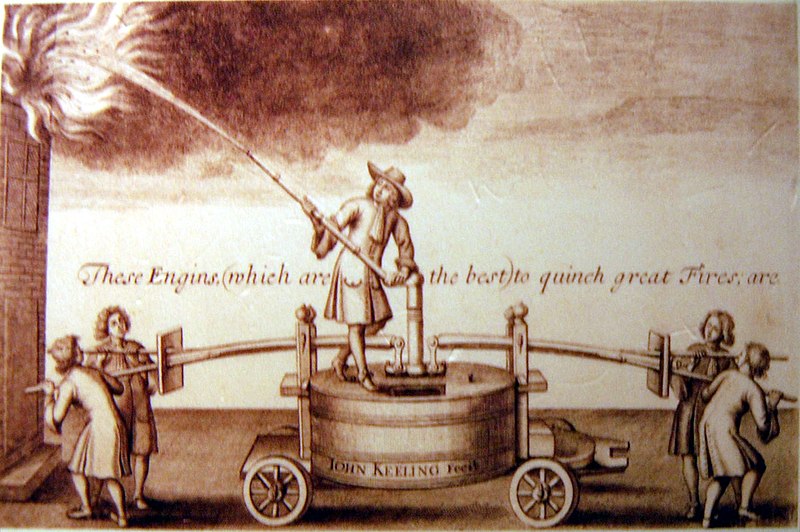
Back in the day...Aerial Ladder, Calgary Fire Department (1906 or after)
Maybe an alternate solution to standpipes would be?:
"the cask and pail installation is sometimes classed as the Miller's greatest protection against fire, and nearly all mills have them on the whole, they are well maintained."
For example,
"barrels of water to be distributed throughout the plant at intervals of about 50 feet supplemented by non freezing fire extinguishers to reach high places, such as elevator head, shafting, tighteners, idlers, etc., where a pail of water cannot be thrown with any degree of accuracy when especially in high ceilings"
Hazards of Grain Elevators by G. W. Cloidt, H. B. Maguire, C. H. Roberts , Armour Institute of Technology (1917)
Interesting viewpoint where closely after the turn of the 20th Century observation. "Practically, standpipe systems in grain elevators are nearly useless. No doubt they look protective and some millers favor them but, even when properly installed and maintained, they are of little value. The standpipe in grain elevators is an indirect method i, e., one man cannot handle the system alone, because the standpipes themselves due to low temperature, must be dry, with valves, mains or pumps in the boiler room etc."
"In this condition, the standpipe system is being set into operative condition, the fire is gaining headway so as to drive out the man or man about to hold hose. The hose is usually neglected and liable to burst as soon as pressure is applied. They usually require more than one man for the play pipe work and, employees seldom risk their lives to save the property in this manner."
NIOSH Accident Report Catastrophic Coal Storage Silo Explosion
"Do not use water or traditional fire fighting foam; however, micelle
encapsulator fire extinguishing agent, such as F-500, should be used.
NFPA 1620, Standard for Pre-Incident Planning can be used to establish a
pre-incident plan for silos within their jurisdiction so as to minimize
the risk to emergency responders" NIOSH Accident Report
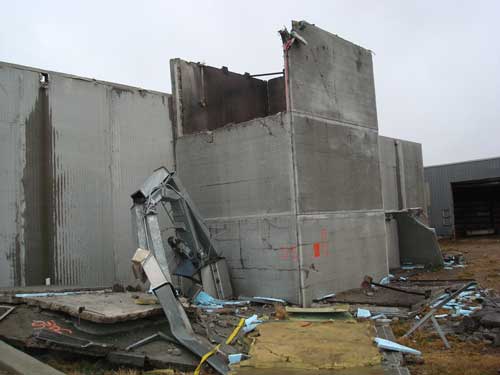 |
| Coal storage silo after explosion (NIOSH photo) |
Excellent job NIOSH sharing this educational accident report with the public providing valuable seven recommendations This will assist immensely in minimizing the severity of future combustible dust related accidents. CDPI encourages additional items in future recommendations regarding fire service emergency response to combustible dust related incidents throughout the manufacturing and non-manufacturing sectors:
Item #1: Fire departments should review, revise and enforce standard operating guidelines (SOGs) for structural fire fighting addressing responding to all combustible dust related incidents.
Item #2 Fire departments should train officers and fire fighters on the hazards associated with different types of processes handling and processing combustible particulate solids (CPS) and the appropriate fire fighting tactics.
Item #3: Fire departments should ensure that pre-emergency planning is completed for all processes handling and processing combustible particulate solids (CPS) within fire department jurisdictions. For example, a topic not yet addressed in NFPA 1620 Chapter 8.4, Special Hazard Considerations –combustible dust.
Item #4: Fire departments should ensure that a separate Incident Safety Officer, independent from the Incident Commander, is appointed at each structure fire and is knowledgeable of combustible dust related fire and explosion hazards.
Item #5: Municipalities should consider requiring that placards with hazard warnings and appropriate fire fighting guidelines be placed on buildings, bulk storage enclosures, air material separators, or other process equipment where the is a danger of a combustible dust deflagrations. Example: Hazard Warning Sign - Danger Explosive atmosphere
It is essential the fire service be acknowledged as a valuable and essential stakeholder in addressing combustible dust related fire and explosion workplace hazards. NIOSH and OSHA must work in a collaborative nature which must welcome the inclusion of the US Fire Administration.
On the other side of the coin the NIOSH accident report missed the boat when not including all high risk occupancies that handle, manufacture, process, combustible particulate solids. Solely limiting the recommendations to silos ignores the big picture of combustible dust related fire and explosion hazards the fire service is exposed to on a daily basis.
For example, over 70% of the recommendations in this recent NIOSH report were copied and pasted from an earlier accident report " Volunteer Assistant Fire Chief Dies at a 2010 Silo Fire/Explosion - New York" It is this type of future NIOSH recommendation that will finally include the fire service as a vital stakeholder in the current OSHA combustible dust rulemaking process. Do we have to wait for another firefighter fatality to finally get it right?
Examples of prior combustible dust related incidents with firefighter injuries:
Firefighter suffers second-degree burns battling blaze at facility in Monroe, OH (May 2012) "While attempting to extinguish the fire, Fire Chief John Centers said “there was a dust explosion” that caused the three injuries.""
Three firefighters injured after fire at Lumber mill in Gaston August 2011 "Firefighters were mopping up a fire that started in a powerhouse at the Lumber mill when a pipe exploded on a walkway, injuring them. "
BURNSVILLE, Minn. Explosion at Black Dog powerplant injures firefighters (August 2010)
"An Xcel spokesperson says the incident started as a smoldering fire in a coal hopper Firefighters were called, and were working the blaze when the explosion occurred around
Surgoinsville,TN firefighter injured in blast a Phipps Bend plant in TN (August 2009) (recycling newspaper to process oil absorbent pads) "a five-year veteran of the department, was standing near a storage bin where firefighters were cleaning up after attempting to extinguish burning fibers which had been ignited by sparks from a grinder, when an unexpected explosion occurred, according to Fire Chief Murlice Carpenter."
Six Stockton, California firefighters slightly hurt in plant explosion (Sept. 2008) "Five firefighters were just inside the building and one just outside the building on stairs when the explosion occurred. The firefighter on the stairs was the firefighter who suffered the worst of the injuries."
Pella, Iowa (Nov 2005) Two firefighters are recovering today after two explosions company "As firefighters tried to put out the fire, another explosion took place. "
Resources:
NIOSH Fatality Accident Report-fire in coal storage silo
NIOSH Fire Fighter Fatality Investigation and Prevention Program
Presentation by Tim Merinar & Tom Hales (NIOSH/DSR) entitled "NIOSH Fire Fighter Fatality Investigation and Prevention" at public stakeholder meeting;
 [PDF - 11.5 MB]
Combustible Dust Related Fire, One Million Dollar Loss
Combustible dust-related fires with no fatalities nor injuries would not fit into their programming, especially with the host inaccurately informing American viewers "Since 1980, there have been at least 350 such explosions in the U.S., killing 133 people and injuring hundreds more." Quite disturbing since we all know the 2006 U.S. Chemical Safety Board Combustible Dust Hazard Investigation Report included both combustible dust fires and explosions from the 1980-2005 timeframe.
Seems almost like yesterday, with the 60 Minutes Executive Producer calling here to Texas from New York City inquiring if I knew of any facilities destroyed from dust explosions immediately following the Feb. 7, 2008 catastrophic Imperial Sugar Refinery explosion where he could send a CBS film crew to.
I said no, I didn’t know of any facilities destroyed by dust explosions but did know of a facility destroyed by combustible dust related fire like in this unfortunate Boca Raton, Florida Cabinetry Shop incident Mainstream sensationalistic networking doesn’t want to hear about mundane fires. Instead they need explosions causing death and destruction to wake up couch potatoes viewing the boob tube on Sunday evening.
Alas, the stage was set for the following next half decade where the drama would unfold. Where now even OSHA stating in prior press releases, all incidents are dust explosions. But after all if 60 Minutes says it is so, must be fact, as all us baby boomers from a long ago era use to believe. If stakeholders don’t acknowledge the initial root of catastrophic dust explosions is fires (fire triangle on steroids) we’ll never identify the root of this systemic global problem.
Tuesday, July 3, 2012
Media continues to ignore the BC Fire Code
"Standards addressing the explosive dangers of wood dust were not set
until after the second deadly explosion in April of this year." This is
totally inaccurate as the BC Fire Code referencing the NFPA combustible
dust standards has for years been the standard in British Columbia regarding workplace combustible dust fire and explosion hazards. The BC Office of the Fire Commissioner enforces the BC Fire Code not WorkSafeBC.
Continuing to
ignore the BC Fire Code will have severe consequences for all
facilities that generate combustible dust.
Solely singling out sawmills in British Columbia is a sure path
to disaster. The question is not if, but when the next combustible dust related incident
will occur at a facility that has no relationship to sawmills. All
stakeholders that handle, process, or generate combustible dust must make a
concerted effort in familiarizing themselves with the BC Fire Code
referencing the NFPA combustible dust standards. Currently stakeholders are
on borrowed time while the clock is ticking.
NEMA Type 9 Enclosures Only for Class II Hazardous Locations?
Currently NEMA only defines Type 9 Enclosures for Class II Hazardous
Locations. In contrast, Dusttight enclosures are referenced in NEMA 250
solely for Nonhazardous Locations.(Table 1) This conflicts with NFPA 70 Articles
500 & 502 in addition to the OSHA HazLoc regulation 1910.307 where
dusttight enclosures are compliant in Class II Division 2 HazLoc.
Would clarification in future revisions of NEMA 250 assist stakeholders
in providing consistency with NFPA 70 Articles 500 & 502 and the
OSHA HazLoc regulation regarding dusttight enclosures in Class II
Division 2 HazLoc?
Resource
NEMA Enclosures for Nonhazardous & Hazardous Locations


 RSS Feed Subscribe
