Pages

Showing posts with label US Fire Administration. Show all posts

Sunday, November 25, 2012

Déjà vu Firefighters Killed & Injured in Repeatable Deadly Silo Explosions

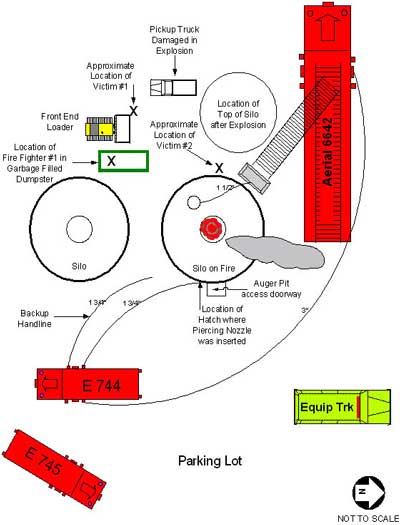
Diagram. Aerial view of incident scene after 1997 explosion

Is anyone out there reading these accident reports prepared by the United States Fire Administration (1997) and NIOSH (2003)? Doesn't appear anyone is especially with the multitude of catastrophic incidents mirrored after each other like reruns on the television.

Time is way overdue for firefighting training on the practical aspects of combating combustible dust related fires. We already know about the physicochemical properties of combustible dust with the wealth of literature out there. Now is the time to get down dirty out on the training fire ground.

A real concern is in these two accident reports is continued mention of oxygen-limiting silos. This is incorrect as they were no longer oxygen-limiting silos but instead modified oxygen-limiting silos. Big difference between the two. Adding water to the top of any silo in conjunction with simultaneously opening access doors at the bottom and poking around with smoldering contents is wrought with danger. Do you feel lucky?


U.S. Fire Administration Fire Investigations Program:
The U.S. Fire Administration develops reports on selected major fires throughout the country. The fires usually involve multiple deaths or a large loss of property. But the primary criterion for deciding to do a report is whether it will result in significant “lessons learned.” In some cases these lessons bring to light new knowledge about fire--the effect of building construction or contents, human behavior in fire, etc...
 

Resources:

Tuesday, November 13, 2012

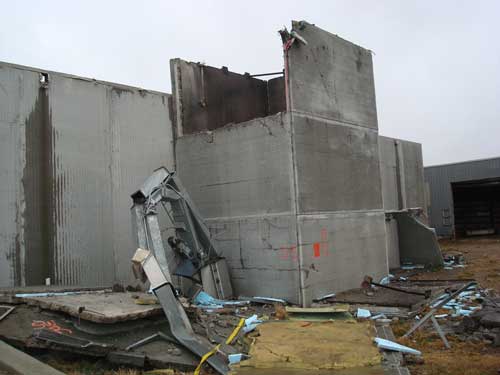
NIOSH Accident Report Catastrophic Coal Storage Silo Explosion

"Do not use water or traditional fire fighting foam; however, micelle encapsulator fire extinguishing agent, such as F-500, should be used. NFPA 1620, Standard for Pre-Incident Planning can be used to establish a pre-incident plan for silos within their jurisdiction so as to minimize the risk to emergency responders" NIOSH Accident Report 

Coal storage silo after explosion
(NIOSH photo)


Excellent job NIOSH sharing this educational accident report with the public providing valuable seven recommendations This will assist immensely in minimizing the severity of future combustible dust related accidents. CDPI encourages additional items in future recommendations regarding fire service emergency response to combustible dust related incidents throughout the manufacturing and non-manufacturing sectors:


Item #1:
Fire departments should review, revise and enforce standard operating guidelines (SOGs) for structural fire fighting addressing responding to all combustible dust related incidents.

Item #2 Fire departments should train officers and fire fighters on the hazards associated with different types of processes handling and processing combustible particulate solids (CPS) and the appropriate fire fighting tactics.

Item #3: Fire departments should ensure that pre-emergency planning is completed for all processes handling and processing combustible particulate solids (CPS) within fire department jurisdictions. For example, a topic not yet addressed in NFPA 1620 Chapter 8.4, Special Hazard Considerations –combustible dust.

Item #4: Fire departments should ensure that a separate Incident Safety Officer, independent from the Incident Commander, is appointed at each structure fire and is knowledgeable of combustible dust related fire and explosion hazards.

Item #5: Municipalities should consider requiring that placards with hazard warnings and appropriate fire fighting guidelines be placed on buildings, bulk storage enclosures, air material separators, or other process equipment where the is a danger of a combustible dust deflagrations. Example: Hazard Warning Sign - Danger Explosive atmosphere

It is essential the fire service be acknowledged as a valuable and essential stakeholder in addressing combustible dust related fire and explosion workplace hazards. NIOSH and OSHA must work in a collaborative nature which must welcome the inclusion of the US Fire Administration. 


On the other side of the coin the NIOSH accident report missed the boat when not including all high risk occupancies that handle, manufacture, process, combustible particulate solids. Solely limiting the recommendations to silos ignores the big picture of combustible dust related fire and explosion hazards the fire service is exposed to on a daily basis.

For example, over 70% of the recommendations in this recent NIOSH report were copied and pasted from an earlier accident report " Volunteer Assistant Fire Chief Dies at a 2010 Silo Fire/Explosion - New York" It is this type of future NIOSH recommendation that will finally include the fire service as a vital stakeholder in the current OSHA combustible dust rulemaking process. Do we have to wait for another firefighter fatality to finally get it right?


Examples of prior combustible dust related incidents with firefighter injuries:

Firefighter suffers second-degree burns battling blaze at facility in  Monroe, OH (May 2012)  "While attempting to extinguish the fire, Fire Chief John Centers said “there was a dust explosion” that caused the three injuries.""

Three firefighters injured after fire at Lumber mill  in Gaston August 2011 "Firefighters were mopping up a fire that started in a powerhouse at the  Lumber mill when a pipe exploded on a walkway, injuring them. "

BURNSVILLE, Minn. Explosion at Black Dog powerplant injures firefighters (August 2010)
  "An Xcel spokesperson says the incident started as a smoldering fire in a coal hopper Firefighters were called, and were working the blaze when the explosion occurred around

Surgoinsville,TN
firefighter injured in blast a Phipps Bend plant in TN (August 2009) (recycling newspaper to process oil absorbent pads) "a five-year veteran of the department, was standing near a storage bin where firefighters were cleaning up after attempting to extinguish burning fibers which had been ignited by sparks from a grinder, when an unexpected explosion occurred, according to Fire Chief Murlice Carpenter."

Six Stockton, California firefighters slightly hurt in plant explosion (Sept. 2008)  "Five firefighters were just inside the building and one just outside the building on stairs when the explosion occurred. The firefighter on the stairs was the firefighter who suffered the worst of the injuries."

Pella, Iowa (Nov 2005) Two firefighters are recovering today after two explosions company  "As firefighters tried to put out the fire, another explosion took place. " 


Resources: 

NIOSH Fatality Accident Report-fire in coal storage silo 
NIOSH Fire Fighter Fatality Investigation and Prevention Program
Presentation by Tim Merinar & Tom Hales (NIOSH/DSR) entitled "NIOSH Fire Fighter Fatality Investigation and Prevention" at public stakeholder meeting; Adobe PDF file [PDF - 11.5 MB]

Thursday, May 10, 2012

GAO Report Results: OSHA and NIOSH Need to Work Together

Occupational health and safety should not solely be inspection, enforcement, and rulemaking. Regarding combustible dust workplace fire and explosion hazards, outreach, education, training, and research is essential. All these elements are included in the OSH Act. The enlightening GAO report sheds light on the fact that the OSH Act is not being adhered to. I encourage all EHS professionals to read the OSH Act, Sections 20, 21, 22

Solely relying on a regulation in providing a warm and fuzzy feeling is not the complete solution. A prime example, would be the multitude of grain elevator explosions following the OSHA Grain Facility Standard  So now we have reached a point where X fatalities is not acceptable but Y fatalities is acceptable. OSHA does not have the resources to be everywhere at once. The time has now come in the 21st century where the paradigm must change to shared responsibility engaging all stakeholders.


In contrast,  "Clinical Professor of Environmental and Occupational Health Michael Silverstein claimed that OSHA and NIOSH have been working together for the past 40 years"
Then why  hasn't NIOSH been a primary stakeholder in the OSHA Combustible Dust rulemaking?
Full Committee Hearing - Time Takes Its Toll: Delays in OSHA’s Standard-Setting Process and the Impact on Worker Safety.
 

Maybe this GAO report will open dialogue on establishing and coordinating local, state, and federal standardization, interoperability, compatibility, and responder health and safety to prepare for, train and respond to, mitigate, and recover from any incident by identifying requirements for an all-hazards incident response which includes OSHA, NIOSH, and US Fire Administration?

"The InterAgency Board (IAB) is a voluntary collaborative panel of emergency preparedness and response practitioners from a wide array of professional disciplines that represent all levels of government and the voluntary sector. The IAB provides a structured forum for the exchange of ideas among operational, technical, and support organizations to improve national preparedness and promote interoperability and compatibility among local, state, and federal response communities."
Doesn't catastrophic ComDust related fires and explosions in the workplace warrant federal standardization, interoperability, and compatibility?

GAO Report: WORKPLACE SAFETY AND HEALTH, Multiple Challenges Lengthen OSHA’s Standard Setting.

"Improve coordination with other agencies: Experts and agency officials noted that OSHA has not fully leveraged available expertise at other federal agencies, especially NIOSH, in developing and issuing its standards. OSHA officials said the agency considers NIOSH’s input on an ad hoc basis but OSHA staff do not routinely work closely with NIOSH staff to analyze risks of occupational hazards. "

"However, OSHA can coordinate more routinely with NIOSH on risk assessments and other analyses required to support the need for standards, saving OSHA time and expense. In our report being released today, we recommend that OSHA and NIOSH more consistently collaborate on researching occupational hazards so that OSHA can more effectively leverage NIOSH expertise in its standard-setting process. Both agencies agreed with this recommendation."
This is only the tip of the iceberg of agencies not working together regarding workplace ComDust fire and explosion hazards. For example, OSHA has ignored the US Fire Administration in the ComDust Rulemaking process. When a ComDust related fire goes beyond the incipient stage, who you going to call to extinguish the fire? 

Resources:
Multiple Challenges Lengthen OSHA's Standard Setting (GAO Report)

Monday, January 17, 2011

Legislators, More Regulation is the ComDust Cure

Why is it that legislators seem to think that passing more bills and regulations is the cure all? Problem with the combustible dust issue is that no one in Washington D.C. has all the facts and solely utilizing the Chemical Safety Board's Dust Hazard Study provides a false perception of the enormity and complexity of the issues both social and economical.

"Their bill would tell OSHA to issue - within 90 days - an interim standard. It would require better housekeeping, engineering controls, worker training and a written combustible-dust safety program."
Savannahnow.com-news article

For example, the CSB report states there were 281 ComDust incidents from 1980-2005, or an average of eleven incidents annually. In stark contrast, according to media accounts of ComDust related incidents since 2008 there have on an average 12 incidents a month. This would equate to approximately 4,000 ComDust incidents during the 1980-2005 timeframe.

Not understanding the depth of the issue is only part of the problem. For example FEMA/U.S. Fire Administration's, "National Fire Incident Reporting System 5.0 (NFIRS)" via local fire departments has failed to report and identify process situations, process conditions, and process materials regarding combustible dust related fires, precursors to catastrophic dust explosions.

If the local fire and explosions hazards can't be identified, then how can they be evaluated and controlled? Of course legislators at the national level seem to think legislation and regulation is the answer for a local/regional problem. That is the easy way out in attempting to solve a primarily fire life safety issue and secondarily an occupational safety issue.

The OSH ACT specifically states that to address workplace safety, issues of regulation, education, outreach, and research must be pursued. OSHA with its limited resources cannot do it all.

"by providing for research, information, education, and training in the field of occupational safety and health; and for other purposes."

What happened to NIOSH as the OSH ACT intended in getting involved with outreach/education regarding the combustible dust issue as it had done decades ago concerning coal mine dust explosions, prior to when the U.S Bureau of Mines (USBM) was transferred to NIOSH, Department of Energy (DOE), U.S. Geological Survey, and the Bureau of Land Management in 1995-97.

Let’s all grow up and stop singling out Imperial Sugar explosion as the problem. Currently Imperial Sugar is an industry leader in addressing ComDust fire and explosion hazards. What about the tens of thousands manufacturing facilities that have potential ComDust fire and explosion hazards? So now OSHA as Secretary of Labor states, "there's a new sheriff in town." So what we going to do, fine them all?

Outreach, training, research, and education through NIOSH and US Fire Administration are just a few examples in alternatives to more legislation and regulation. Question is, who has the vision in providing the leadership so all local, state, and federal agencies are working together in these tough economic times.

Resources -OSH Act

Thursday, January 13, 2011

U.K Combustible Dust Fire with Metal Dust

The fire was on the mezzanine floor in a hopper containing metal dust"
www.miltonkeynes.co.uk

OSHA needs to look at DSEAR and ATEX and include ComDust in the universe of potentially explosive atmospheres in the rulemaking process, which also includes flammable liquids, gases, vapors, and mists. Can't continue like the present situation in the USA with ComDust as a separate entity. Until then, the US Fire Administration will continue to ignore the fire and explosion hazards of ComDust with deficient incident reporting in the National Fire Incident Reporting System NFIRS 5.0

Wednesday, January 12, 2011

Combustible Dust Fire Incident Reporting Deficiencies

A problem arises in the national fire reporting system where there are no data elements specifically identifying manufacturing process equipment involved in ignition of combustible dust. If process condition fire hazards can't be identified, then how can they be properly evaluated and controlled through administrative, PPE and best engineering practices?

"Stakeholders seeking control measures to minimize the probability and severity of combustible dust incidents should work more closely with the fire service."

ohsonline.com-article

Posted via email from ComDust

Resources:

1. National Fire Incident Reporting System (NFIRS 5.0) Complete Reference Guide

2. Report on Confined Structure Fires-February 2006, US Fire Administration

3. U.S. Industrial and Manufacturing Property Structure Fires, Oct. 2009, NFPA Fire Analysis and Research Division

4. US Chemical Safety Board, Combustible Dust Hazard Investigation, Nov. 2006

5. NFPA 901 Standard Classifications for Incident Reporting and Fire Protection

Combustible Dust Fires. "It's the nature of the business"

Fire Chief states, "It's the nature of the business." "Part of the problem is the nature of the process that's there. It lends itself to having a fire to begin with. And it's not their fault" Caledon Enterprise

That is the problem here in the USA as many fire departments also believe it's the nature of the business and not the facilities fault. Fires in hoppers, dust collectors, etc. are really confined structure fires occuring in non-combustible containers in addition to in most cases; no fatalities, minor injuries, and no property damage.

Basically we are talking about a smoke scare and that is why these incidents are not reported in the US Fire Administration NFIRS 5.0. Why do we have to wait for a catastrophic ComDust explosion to take proactive action?

Posted via email from ComDust


Questions, Problems, Feedback? Please send email by clicking this link...Thanks

©Copyright 2008-2012. Combustible Dust Policy Institute
The information in http://dustexplosions.blogspot.com/ is not meant to be a substitute for the Code of Federal Regulations (CFR), Federal Register, and other OSHA documents, which should serve as the primary source of regulatory guidance. The information on this site should not be used in place of appropriate technical or legal advice related to your company's specific circumstances. Combustible Dust Policy Institute tries to provide quality information, but we make no claims, promises or guarantees about the accuracy, completeness, or adequacy of the information contained in or linked to this web site and its associated sites. Combustible Dust Policy Institute has no liability arising from or relating to the use, interpretation, or application of the information or its accuracy or inaccuracy. Copyright notice: All materials in this site are copyrighted by the Combustible Dust Policy Institute. No materials may be directly or indirectly published, posted to Internet and intranet distribution channels, broadcast, rewritten for broadcast or publication or redistributed in any medium without permission.