This morning at the mark-up of "H.R. 5522, Combustible Dust Explosion and Fire Prevention Act of 2008", the Full Committee of the House Education and Labor voted and agreed that this important bill should move forward onto the House floor. Over the past eight weeks, since the catastrophic Imperial Sugar Refinery explosion there has been 31 combustible dust related explosions and fires, which included six dust explosions in March. In April alone, there's been five combustible dust fires at flooring, paper, dental, and food manufacturing facilities. Luckily no fatalities or injuries in these April incidents. Luck only goes so far at the roulette wheel..
Wednesday, April 9, 2008
H.R. 5522,Combustible Dust Bill Moves to House Floor

Monday, April 7, 2008
Video: Mitigation Combustible Dust Explosion
Here is a short video simulating a combustible dust explosion in a silo or bucket elevator where the explosion panels take the brunt of the blast. The end result would be the protection of property and personnel.
1,000th Visitor Today
Thanks to all the visitors who have ended up on the Combustible Dust Explosion and Fire blog. I know now that the efforts in providing helpful information regarding combustible dusts have not gone in vain. It be sort of strange making posts and no one reading them ...sort of like talking to myself.
Since the first post on March 1, I've learned quite a bit and learning more everyday about the various manufacturing processes that handle combustible particulate solids that generate combustible dusts. Every process has it's unique characteristics in generating combustible dust and it's important that the plant manager obtain an awareness of this complex subject and share this knowledge with all the employees in the company health and safety training program.
When I see Google search terms come up, such as minimum explosive concentration of grain dust
Thanks again for visiting the site and be sure to leave your comments following the posts. That would help in generating constructive dialog on the subject. If the music that I added to the site becomes to irritating you can just click the pause button at the top left of the page.
Being that many blue-collar workers in the manufacturing industry work the shift schedule I figured it would be appropriate to add Kenny Chesney's song "Shiftwork" to the site. That what this site is all about...protecting all workers from the consequences of combustible dust explosions and fires, whether they work shift or not. It doesn't help that unfortunately I work shift also. So when I first heard the song..I thought yeah, I can relate to that. So for others who don't work shift you are not missing anything. But now you have an idea of what it's all about while you browse the contents of the site.
Book Review: Electrostatic Ignition Combustible Dust
Over the past eight weeks since the tragic Imperial Sugar Refinery combustible dust explosion I've been busy seeking any information that is available concerning the causes and prevention of combustible dust fires and explosions. One subject that has come up is minimum ignition energy (MIE), which is the energy in millijoules from electrostatic discharges or static electricity that can ignite combustible dusts generated from combustible particulate solids in the manufacturing process.
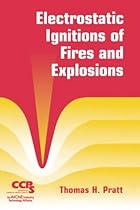
An excellent book published by the American Institute of Chemical Engineers is "Electrostatic Ignition of Fires and Explosions" by Thomas H. Pratt . This book is an easy read and no prior background in engineering is necessary, which enables everyone in obtaining an understanding of static electrical hazards in the workplace.
The chapters start out with basic concepts then moves on to accumulation, separation, and discharge of electrical charges. Once that concept is mastered, minimum ignition energies can be grasped into how they apply in the workplace. As the book progresses, the author takes the reader into various areas in the manufacturing process dealing with liquids, mists, and finally powders.
With the idea of how static electricity originates the reader is presented with design and operating criteria in addition to electrostatic measurements, and quantification of electrostatic scenarios. Finally at the conclusion and last chapter case histories are provided where the reader is actually able to see how combustible dust explosions and fires occurred when minimum ignition energy ignited dusts.
For many including myself I had no idea what the terms propagating brush or brush discharges meant in regards to minimum ignition energy. Prior to reading the book I thought brush discharges had to do with brushes in an electircal motors but that is not so.
If you have combustible dust in the workplace in any form it's imperative that you understand what minimum ignition energy is. Especially since in the material safety data sheets (MSDS) of the explosive and fire hazard section, this property is not listed like flash points are listed for flammable liquids.
Criminal Charges Recent Explosion in Serbia
They don't mess around when it comes to plant explosions in Belgrade, Serbia. An explosion over the weekend at a pesticides storage facility put 29 people, mostly firefighters in the hospital. The Environmental Ministry is filing criminal charges against the responsible person. Is it possible that someone high in management could be sitting in a courtroom soon explaining why the incident occurred and what preventive and mitigative measures the facility had?
I wonder how far plant explosions would be reduced in the United States if criminal charges where filed by governmental entities immediately after an explosion? It's great here in the United States that criminal charges are really not considered after the majority of events, just a small fine and slap on the wrist. Fatalities and injuries in the cost benefit analysis are cheaper than voluntary administrative and technical preventive and mitigative measures. Thankfully we live in a free country of laissez faire.
Canadian Neighbor Combustible Dust Explosion
The six combustible dust explosions last month is not limited to incidents in the United States. Over the weekend a combustible dust explosion occurred at Associated Proteins, in Ste Agathe, Canada. Associated Proteins, a canola processing facility, and the largest expeller-pressed oilseed crushing plant in the world has a state-of-the art facility which has gone to great expense to ensure the most cutting edge technology is used in their manufacturing process. An educational video concerning the canola manufacturing process can be viewed on their web site.
So how can a plant that is so clean experience a dust explosion? Poor housekeeping is out of the question. OSHA's mantra concerning the prevention of future combustible dust explosions and fire is good housekeeping. True, housekeeping is important, but this is only one priority and that is where the current OSHA voluntary program fails miserably in preventing future combustible dust explosions and fires.
Complex Pathways
The pathways concerning the molecular fragments that generate a combustible dust explosion and fire are more complex that just housekeeping. In any manufacturing process electrical charges are constantly being separated, accumulated, and dissipated in the form of electrostatic discharges or static electricity. At this level it doesn't take much to ignite a cloud or layer of combustible dust generated from combustible particulate solids of metals, food products, wood or plastics. So even if good housekeeping is adhered to the potential for an incident persists as dusts are inherently part of the process where an potentially explosive atmospheres coexist.
It would turn into a terrible day at petrochemical plants if the explosive atmospheres from flammable vapors were ignored like is the case with combustible dust. Think explosive atmospheres....combustible dust and flammable vapors. It's all the same yet that is where the disconnect is here in the United States. Yet the majority of stakeholders do not believe combustible dusts can provide an explosive atmospheres on a regular basis.
MSDS Information Nonexistent
On the other end of the spectrum there are facilities that accumulate combustible dusts in the manufacturing process and are not aware of the hazards involved. Just last week, Quality Cushion and Pad in Georgia experienced a combustible dust fire that destroyed the facility where housekeeping was questionable according to the news report.
If the proper information on the fire hazards such as minimum ignition temperature, minimum explosive concentrations, and minimum ignition energy were included in the Material Safety Data Sheets (MSDS), incidents like this could be prevented. The big question is, who's responsibility is it to include this vital information in the MSDS...the raw product supplier or the company? In this case, that could be quite complex since this facility receives millions of pounds of recyled polyurethane foam by the truckload from thousands of sources.
Explosion Protection Document
Combustible dust explosions and fires are a global problem. Our global trading partners in the European Union, United Kingdom, Australia, and the New Zealand are already addressing the problem with the requirement that facilities develop an explosion protection document. The recent example of the unfortunate Canadian incident highlights that poor housekeeping is not the sole cause of combustible dust explosions and fires.
It's time that all facilities in the United States large or small review the combustible dust hazards in their workplace and prepare their own explosion protection document. If you don't know the minimum ignition temperature (MIT) or minimum ignition energy (MIE) of the combustible dust at your facility then please find out now. Until then you are on borrowed time.
Subscribe to:
Posts (Atom)


 RSS Feed Subscribe
