Until the horrific combustible dust explosion at Imperial Sugar Refinery over two months ago, most of the nation had no idea that seemingly harmless coffee creamer and sugar poured into a cup of coffee jump starting us with a morning java jolt could also create another type of jolt, yet devastating . Many of the same food products found on the aisles of the local grocery store have the explosive power of gunpowder when suspended and ignited in a confined space such as a manufacturing facility.
Information gathered from OSHA's National Emphasis Program on combustible dust in conjunction with the Chemical Safety Boards Combustible Dust Study provides a conservative glimpse of over 100,000 firms in the United States that utilize raw combustible particulate solids of wood, rubber, plastic, metals, food, chemicals, and pharmaceuticals, which could generate explosive atmospheres. When the manufacturing process begins, combustible dusts are generated. Military and police forces use the same physics of a dust explosion in fuel-air bombs that generate controlled dust explosions.
The United States military has been very successful with fuel-air thermobaric bombs hitting the enemy caves in Afghanistan with the Hellfire missile. Police SWAT teams also have an application for controlled combustible dust explosions with flash-bang grenades that utilize a mixture of aluminum and potassium perchlorate dust. Yes, this is the same dust thats caused many combustible dust explosions and fires in the metal and chemical process manufacturing industries over the past several decades.
Combustible dusts are commonplace occurrence in our daily lives; in the packages on the grocery store aisles, military arsenals, community police tactical equipment, in addition to the manufacturing process. Once an awareness of combustible dust is acknowledged, then the proper mitigative and preventative measure can be instituted. Just don't go hiding in any caves or get the SWAT teams upset, theres no mitigation there.
Friday, April 25, 2008
Controlled ComDust Explosion: Flash-Bang!


Monday, April 7, 2008
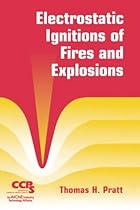
Book Review: Electrostatic Ignition Combustible Dust
Over the past eight weeks since the tragic Imperial Sugar Refinery combustible dust explosion I've been busy seeking any information that is available concerning the causes and prevention of combustible dust fires and explosions. One subject that has come up is minimum ignition energy (MIE), which is the energy in millijoules from electrostatic discharges or static electricity that can ignite combustible dusts generated from combustible particulate solids in the manufacturing process.
An excellent book published by the American Institute of Chemical Engineers is "Electrostatic Ignition of Fires and Explosions" by Thomas H. Pratt . This book is an easy read and no prior background in engineering is necessary, which enables everyone in obtaining an understanding of static electrical hazards in the workplace.
The chapters start out with basic concepts then moves on to accumulation, separation, and discharge of electrical charges. Once that concept is mastered, minimum ignition energies can be grasped into how they apply in the workplace. As the book progresses, the author takes the reader into various areas in the manufacturing process dealing with liquids, mists, and finally powders.
With the idea of how static electricity originates the reader is presented with design and operating criteria in addition to electrostatic measurements, and quantification of electrostatic scenarios. Finally at the conclusion and last chapter case histories are provided where the reader is actually able to see how combustible dust explosions and fires occurred when minimum ignition energy ignited dusts.
For many including myself I had no idea what the terms propagating brush or brush discharges meant in regards to minimum ignition energy. Prior to reading the book I thought brush discharges had to do with brushes in an electircal motors but that is not so.
If you have combustible dust in the workplace in any form it's imperative that you understand what minimum ignition energy is. Especially since in the material safety data sheets (MSDS) of the explosive and fire hazard section, this property is not listed like flash points are listed for flammable liquids.
Monday, March 10, 2008
State Dust Emphasis Programs Voluntary
 Get er' Done
Nearly half the nation is unprotected concerning having the proper knowledge concerning the hazards of combustible particulate solids and the resulting combustible dusts. For instance, OSHA instituted a Combustible Dust National Emphasis (NEP) Program in October 2007, which provides health and safety inspectors with the background information needed in conducting facility inspections and informing industry of combustible dust hazards in 28 states. This is all fine and dandy.
Yet in the other 22 states with approved State OSHA programs, federal inspectors are not involved only state inspectors work in this area. Additionally, State plan participation in this national emphasis effort is strongly encouraged but is not required. Strongly encouraged means voluntary, which is the heart of the problem.
For example, North and South Carolina, and Kentucky have no local emphasis program for combustible dusts. Since the Dixie Crystal sugar Refinery explosion there has been two combustible dust related incidents in these states at rubber and textile facilities.
View Larger Map
Indiana, Michigan, and Tennessee are in the process of adopting local emphasis programs for combustible dust hazards. Hopefully other states that have their own OSHA program will follow suit. For others that are under the federal National Emphasis Program, it will take additional congressional appropriations so that OSHA can hire additional inspectors to insure the nation's industrial infrastructure is secure.
Sunday, March 9, 2008
Combustible Particulate Solids vs. Dust Confusion
Hopefully the confusion in terminology regarding combustible particulate solids and combustible dusts will be cleared up prior to the House Education and Labor Committee hearing on Wednesday morning concerning the ‘‘Combustible Dust Explosion and Fire Prevention Act of 2008’’. With so many important policymakers being initially introduced to this complex acronym induced topic, it behooves the champions of the cause to get it right the first time out of the box.
First off, lets all understand and be in complete agreement that combustible dusts are a subset of combustible particulate solids (CPS). In its raw form combustible dusts did not arrive at the facility rear loading docks. Instead combustible particulate solids were trucked in. Thats where the Material Safety Data Sheets (MSDS) enter the picture, since these documents communicate the potential hazards of handling combustible particulate solids. which in their initial packaged state are mostly not hazardous at all.
For instance, after the facility receives the combustible particulate solids, the solid is then transformed into a finished product. During the production phase, which can include such activities as shipping, handling, conveying, mixing, pulverizing, etc. It's during this phase that combustible dusts are generated and a potential hazardous atmosphere can develop when minimum explosive concentrations (MEC) are partnered with a minimum ignition energy (MIE) to produce a potential explosion or fire.
Hope that clears up the confusion. Since prior to today and until reading several times over NFPA 654, I really couldn't of won the Wheel of Fortune either, if asked to compare and contrast the two.
Saturday, March 1, 2008
Combustible Dust Hazards: Alarming Trend
http://www.bismarcktribune.com/articles/2008/03/01/news/state/150068.txt
An alarming trend is occurring across the nation at processing facilities in general industry where fires and explosions are occurring repeatedly, especially where combustible dusts are generated. In many instances no injuries or fatalities occur; only damage to the facility and a negative economic impact to the community.
In less fortunate instances, such as the preventable recent tragic Dixie Crystal sugar refinery explosion located in the heart of Dixie, lives are senselessly lost in conjunction with insurmountable physical pain and suffering to workers and their loved ones.
It was only two years ago that the Chemical Safety Board submitted, at the completion of a Combustible Dust Study, a report to the Department of Labor recommending the implementation of an OSHA comprehensive dust standard to protect the health and safety of workers from the hazards of combustible dust explosions and fires. So far the OSHA has failed to act. In the meantime combustible dust explosions and fires continue across a wide spectrum of industries across the nation's heartland.
GRAND FORKS (AP)..."The fire early Thursday morning was contained in the dust collection system at the North American Foods plant..."
In the CSB study for the period of 1980-2005, investigators discovered that over 40 percent of combustible dust fires and explosions occurred in the dust collection systems and 24 percent of these incidents were sparked in food processing facilities such as the one at North American Foods in Grand Forks, North Dakota.
The CSB found that in all industries, dust collectors are the equipment most often involved in incidents;similarly, Zalosh et al. (2005) report that dust collectors account for more than 40 percent of all dust explosions.
Findings of the actual ignition source of the Grand Forks dehydrated potato plant has yet to be determined. In retrospect, all plant managers throughout the nation , through close scrutiny of their Material Safety Data Sheets (MSDS) will have to reassess their current operating procedures to insure minimum explosive concentrations (MEC) and minimum ignition temperatures (MIT) are not breached in the vicinity of potential ignition sources such as non-compliant electrical fixtures.
Biggest challenge is...most MSDS, fail to list these important physical properties in contrast and analogous to flammable liquid flash points listed for petroleum product. Incidents of combustible fires and explosions will continue while the workforce is in the dark in regards to the combustible dusts hazards they are daily working with across the nation.


 RSS Feed Subscribe
