Pages

Showing posts with label process safety management. Show all posts

Monday, April 22, 2013

Media Must Cease in Referring West, Texas Facility as a Fertilizer Plant


Quite alarming when nation-wide stakeholders don't believe they have anything in the magnitude of the West, Texas facility such as a fertilizer manufacturer yet have establishments supplying fertilizers to farmer end-users

Don't kid yourself folks, West Fertilizer was not a fertilizer manufacturer either, as the media incorrectly portrays in many instances. The Texas establishment supplied custom blended fertilizer to farmers in the area as a retail establishment in addition to operating a grain handling facility, yet exempt under the OSHA Process Safety Management (PSM) Standard, while handling a Highly Hazardous Chemical (anhydrous ammonia).

The media incorrectly labels the facility as a fertilizer plant. So a bakery that customs mixes flour and sugar is a flour mill or sugar refinery? As a result of this inaccurate information many stakeholders  don't believe they have potential fire and explosion hazards in their backyard.

This is a dangerous trend where safety professionals must educate the media on the facts before others incorrectly believe no hazards exist. Unfortunately Texas authorities did not learn from the Magnablend catastrophe  especially in regards to Local Emergency Planning Committees (LEPC).

NAICS 42451: Grain and Field Bean Merchant Wholesalers, in addition to West Fertilizer covered under EPA RMP handling anhydrous ammonia with OSHA PSM exemption.

Total number of facilities: 82
Number of deregistered facilities: 10
Number of processes that could reach off-site: 82
Total pounds of toxic chemicals in processes: 28,355,310
Total pounds of flammable chemicals in processes: 0
Number of 5-year accidents: 4
Number of deaths from 5-year accidents: 0
Number of injuries from 5-year accidents: 4
Amount of property damage from 5-year accidents: $0

NAICS 424910, Farm Supplies Merchant Wholesalers, additional establishments in USA under EPA RMP handling anhydrous ammonia with OSHA PSM exemption

Total number of facilities: 3,645
Number of deregistered facilities: 601
Number of processes that could reach off-site: 3,738
Total pounds of toxic chemicals in processes: 6,728,564,906
Total pounds of flammable chemicals in processes: 392,870
Number of 5-year accidents: 138
Number of deaths from 5-year accidents: 3
Number of injuries from 5-year accidents: 191
Amount of property damage from 5-year accidents: $209,774

NAICS 493130, Farm Product Warehousing and Storage. in addition to West Fertilizer covered under EPA RMP handling anhydrous ammonia

Total number of facilities: 260
Number of deregistered facilities: 121
Number of processes that could reach off-site: 267
Total pounds of toxic chemicals in processes: 101,485,227
Total pounds of flammable chemicals in processes: 72,000
Number of 5-year accidents: 5
Number of deaths from 5-year accidents: 0
Number of injuries from 5-year accidents: 4
Amount of property damage from 5-year accidents: $0

RMP was last updated on RTK Net with a set of EPA data made on May 30, 2012

TIER II Reporting To SEPC and LEPC's

Tier II in conjunction with LEPC' is a key element where many chemicals are not triggered with  thresholds in the EPA/RMP or OSHA/PSM programs. In contrast, TIER II when used as intended by the LEPC's engages the necessary hazard awareness on the other side of the fence-line throughout the community in preventing, planning and preparing for future accidents.

What is a Texas Tier Two Report?
"Two types of thresholds that determine whether a hazardous chemical will be included on the Texas Tier Two Report:

#1. There are very low thresholds for any of the listed EPA Extremely Hazardous Substances (500 pounds or the Threshold Planning Quantity in pounds for the specific listed chemical, whichever amount is less).

#2. For all other "generally hazardous chemicals" products which require a Safety Data Sheet (SDS) under the federal Occupational Safety and Health Administration's (OSHA's) Hazard Communication Standard], the threshold for reporting is 10,000 pounds."

LIST OF LISTS
• EPCRA Section 302 Extremely Hazardous Substances
• CERCLA Hazardous Substances
• EPCRA Section 313 Toxic Chemicals
• CAA 112(r) Regulated Chemicals For Accidental Release Prevention

"This consolidated chemical list includes chemicals subject to reporting requirements under the Emergency Planning and Community Right-to-Know Act (EPCRA), also known as Title III of the Superfund Amendments and Reauthorization Act of 1986 (SARA), Comprehensive Environmental Response, Compensation and Liability Act (CERCLA) and chemicals listed under section 112(r) of the Clean Air Act (CAA).

This consolidated list has been prepared to help firms handling chemicals determine whether they need to submit reports under sections 302 and 313 of EPCRA and determine if releases of chemicals are reportable under CERCLA and section 304 of EPCRA. It will also help firms determine whether they will be subject to accident prevention regulations under CAA section 112(r)"


Monday, March 25, 2013

Proposed Combustible Dust Bill Relationship to OSHA Regulations

Proposed Combustible Dust Legislation H.R. 691,Worker Protection Against Combustible Dust Explosions and Fires Act of 2013. Presentation illustrates relationship of proposed combustible dust bill with OSHA regulations. Approximately 40% of the requirements are mirrored from content in the OSHA Fire Prevention Plan 1910.39 in addition to approximately 50% of content analogous to OSHA's Process Safety Management 1910.119 regulations.


Many of the NFPA combustible dust standards also include elements of Process Safety Management (PSM) such as management of change (MOC), accident investigations, contractor training, etc. Additionally elements in the requirements of the proposed bill include: Hazard Assessment 1910.132, Hazard Communication (HazCom) 1910.1200, Process Safety Management (PSM) 1910.119, Lock-out/Tag-out (LOTO)1910.147, and Hot Work 190.252.

The proposed reintroduced legislation fails to address in the "findings" the importance of training, education, outreach, inspections, and enforcement at the local jurisdictional level with the I-Codes such as the International Building Code and International Fire Code which reference the NFPA combustible dust standards. There exponentially  more local building and fire inspectors conducting plan review, permit approval, and inspections than the limited resources of OSHA inspectors working out of distant area offices. Fires can never be effectively regulated at the federal level since fire prevention and protection is a local issue. A cohesive collaboration between local, state, and federal agencies would be a equitable solution in addressing the contentious and complex subject of combustible dust fire and explosion hazards in H-2 High-Hazard occupancies which appear to many as benign deflagration hazards with the continued occurrence of "near misses" throughout all sectors

YouTube video on slide #2 is Representative George Miller (D), Chairman of the Education and Labor Committee, making a statement during floor debate on HR 5522, the Worker Protection Against Combustible Dust Explosions and Fires Act, on April 30, 2008. The bill passed in the House of Representatives April 30, 2008, 6:56 p.m. with a 247/165 simple majority vote but was never passed by the Senate.

Friday, December 25, 2009

Proposed Combustible Dust PSM Standard

Here is an idea on how a proposed OSHA Combustible Dust Process Safety Management Standard (PSM) could look like as an alternative regulatory approach. The commonality of combustible dust fire and explosion hazards in the workplace is process equipment. The most controversial aspect of a proposed ComDust PSM would be the threshold level. This is an area were valuable input from all stakeholders is needed. Many elements of PSM already are incorporated in the NFPA Combustible Dust Standards. So what do you think?

Posted via email from ComDust

Thursday, January 1, 2009

200+ Combustible Dust Fires and Explosions in 2008


A new year is upon us. Will we learn from the past? Through media accounts, the Combustible Dust Policy Institute researched over 200+ combustible dust related fires and explosions that occurred in 2008 in the grain, manufacturing, non-manufacturing, and utility sectors. Good housekeeping is a partial solution in preventing and mitigating incidents, especially in regards to secondary explosions, but only one aspect of a multi-dimensional complex subject concerning combustible dust hazards.

For instance, utilizing good engineering practices (GEP) as outlined in the NFPA Combustible Dust Standards would assist in lessening the likelihood and reducing the severity of many incidents that occurred in 2008. Additionally, administrative controls such as hot work permits, inspection, maintenance, and employee/contractor training of combustible dust hazard awareness would proactively provide enhanced measures cost effectively.

The recent grain facility dust explosion in Arizona is a wake up call that dust explosions are prevalent across all sectors. Combustible dust related fires and explosions is an inherent throughout industry. It's only through mitigative and preventative measures that potential fatalities, injuries, and adverse impact will be lessened.


The Combustible Dust Policy Institute proposes an alternate solution addressing the entire spectrum of combustible particulate solids that generate combustible dust across all sectors. Instead of haphazardly piecing together costly regulations singling out individual occupational sectors. Legislators must be educated that all explosions transform energy into blast waves (overpressure), thermal radiation, and ensuing projectiles. It doesn't matter if its runaway reaction explosion, condensed phase explosion, vapor cloud explosion, or dust explosion.

NFPA 654, "Standard for the Prevention of Fires and Dust Explosions from the Manufacturing, Processing, and Handling of Combustible Particulate Solids," has already provided a good start in considering a regulatory framework with mention of a process hazard analysis as already implemented at refineries with the OSHA process safety management (PSM) program. For instance. 29 CFR 1910.119 is intended to prevent or minimize the consequences of a catastrophic explosion from a process.


What about combustible dust explosions in other occupational sectors that are of high consequence like the catastrophic Imperial Sugar Refinery explosion earlier last year and now this past week the Arizona Grain explosion that sent three workers with burn injuries to the hospital ? Scientific data compiled from laboratory combustible dust testing has proven that the devastating blast waves and thermal radiation from dust explosions are just as devastating as a vapor cloud explosions.

The learning curve is now complete concerning the hazards of combustible dust in the workplace. All stakeholders must cohesively work together with local, state, and national governmental leaders in developing a comprehensive combustible dust occupational safety framework that ensures the safety of all workers in explosive high consequence occupations.

For additional information on identifying, evaluating, and controlling the hazards of combustible dust related fires and explosions, the Combustible Dust Policy Institute in conjunction with the 4th Annual Industrial Fire, Safety, and Security Conference -IFSS 2009 will be hosting a Two Day Combustible Dust Hazard Workshop at the Reliant Center(next to the Astrodome), February 3-4, 2009, in Houston Texas.

Concerned stakeholders will acquire important information during Day One of the workshop that can be utilized in preventing and mitigating future incidents in addition to understanding the necessary steps in achieving regulatory compliance concerning the OSHA Combustible Dust National Emphasis Program.

Currently a situational awareness is lacking nationwide that combustible dust also poses a potential explosive atmosphere in the same light as flammable gases, vapors, and mists. Instead of vapor cloud or BLEVE explosions that occur in the refining sector there are deflagrations and dust explosions in the manufacturing sector.

Day Two of the workshop will include fire-fighting suppression techniques, equipment, and training resources that are currently available. In addition to active participation through panel discussions, Fire Chiefs from around the nation that respond to combustible dust incidents will share successful fire-fighting tactics in combating combustible dust fires.

WHO ATTENDS IFSS Workshops and Seminars?

Attendees from across the United States converge at IFSS every year to meet with their peers - industrial emergency response and security leaders throughout the industrial and energy marketplace.

INDUSTRIAL FIRE, SAFETY & SECURITY Attendees Include:

FEDERAL/STATE/

MUNICIPAL

* Regulatory Agencies
* Emergency Management Departments
* LEPC's - Local Emergency Planning Committees
* Municipal Fire Districts - Mutual Aid

OPERATORS/INDUSTRY

* Oil & Gas Exploration & Production
* Refineries
* Petrochemical/Chemical Facilities
* Pipelines
* Terminals/Storage Facilities
* Power Plants
* LNG Facilities
* Process Industries
* Transportation/Shipping/Rail
* Emergency Response Teams
* Industrial Fire Brigades
* Security

Preparing for Tomorrow’s Emergencies in Today’s World.

EH&S. Hazmat. Fire. Security. Rescue. Safety. Medical.
Whatever aspect of emergency management you work in, IFSS is the essential destination for staying ahead of the curve – and getting that edge that can make all the difference in your next situation.

IFSS delivers an unsurpassed learning experience!

* Learn about best practices for all types of incidents from industry leaders and technical experts.
* Get three days of answers to your most pressing questions.
* Discover the most innovative products and services at a one-of-a-kind exhibition.
* Hear about valuable “lessons learned” from true-life situations.
* Connect with your peers from around the country.

IFSS is only four days… but the value it provides will pay off all year-long. You will take-away intel, insights and info that will help you on an ongoing basis as you protect America's industrial plant facilities, personnel, energy infrastructure, and critical assets against all hazards.


IFSS 2009 Conference Contacts
Phone: (832) 242-1969
Fax: (832) 242-1971

# # #

The goal of Combustible Dust Policy Institute is to minimize the severity and reduce the occurrence of combustible dust related fires and explosions in the global workplace. Through ongoing exchange of best practices and lessons learned of combustible dust related incidents, which identifies and evaluates risk, the Institute shares risk assessment information that a diverse spectrum of members utilize in effectively controlling combustible dust hazards. Assisting stakeholders in this endeavor, health and safety compliance is effectively achieved in addition to reducing preventable workplace fatalities, injuries, and adverse economic impact. Contact John Astad, Chairperson :Combustible Dust Hazard Workshop@ 409-440-7185


Sunday, November 30, 2008

Malt Silo Explosion in Germany kills 1, injures 7

http://www.iht.com/articles/ap/2008/11/30/europe/EU-Germany-Factory-Explosion.php

Here in the USA we all pray for the families and emergency responders that experienced a tragic event quite similar to the Imperial Sugar Refinery dust explosion at Port Wentworth, Georgia in Feb. 2008. The German news account stated, "There was a first explosion at 07.00 AM causing the fire fighters to rush in, then at 09.00 AM there was in the midst of firefighting activities a second explosion, fatal for one fire fighter, injuring 7 others." Sounds eerily familiar, a more deadly secondary explosion.

Combustible dust related fires and explosions are a constant threat to fire-fighters responding to such events. In many instances the hazards of seemingly harmless combustible particulate solids that generate combustible dust are unknown.

The explosion severity of many combustible dusts are quite similar to flammable vapors, liquids, and gases. Currently many national manufacturing industries in the USA have not acknowledged this fact.

This catastrophic event in GLOBAL MALT GMBH & CO KG, in Germany should be a wake up call for stakeholders in the USA in following similar process safety management (PSM) programs that are required by OSHA at petrochemical refineries where a thorough process hazard analysis is conducted, which identifies, evaluates, and institutes control measures in lessening the occurrence and reducing the severity of future events.

Note: You can easily translate from German to English if add the Google Toolbar to your browser. Click the link for free download

Photo Credit: SWR

Resources:

Brewing Process-
Dave Statter's Blog: STATter 911

German News Article
Aftermath Pictures http://is.gd/9Dd6

Sunday, November 23, 2008

PSM Oriented Towards Dust Hazards?

A process safety management (PSM) oriented program that addresses combustible dust hazards in the manufacturing, non-manufacturing, and utility sectors needs to be implemented as it is in the chemical and refinery sectors. The main problem, is a disconnect concerning wood, food, paper, textiles, etc. process streams as not being considered like the 136 highly hazardous chemicals (HHC) as outlined in OSHA's Process Safety Management regulation (29 CFR 1910.119).

OSHA National Emphasis Programs (NEP)
Last year, the OSHA Combustible Dust National Emphasis Program (NEP) became effective four months after the Petroleum Refinery Process Safety Management (PSM) National Emphasis Program (NEP). There is a vast difference in the two OSHA NEP's with the goal of protecting the nations workforce and outlying communities from the harmful effects of industrial fires, explosions, and toxic releases.

In reviewing the background information for the Refinery PSM NEP, its disturbing when comparing and contrasting fatalities and catastrophes(FAT/CAT) between refineries and facilities that handle combustible particulate solids that generates combustible dust. For instance, on pg. 4 the Refinery NEP states:

"According to OSHA’s IMIS database, since May 1992, 36 fatality/catastrophe (FAT/CAT) incidents related to HHC releases in the refining industry have occurred. These incidents included 52 employee deaths and 250 employee injuries, 98 of these injuries required hospitalization."

Fatalities and Catastrophes (FAT/CAT)
Over the same fifteen year period, according to the results of the Chemical Safety Board Dust Hazard Investigation, there were over 95 fatalities and hundreds of injuries as the result of over 160 combustible dust related fires and explosions in the manufacturing, non-manufacturing , and utility sectors. Basically there are three times as many fatalities and catastrophes (FAT/CAT) in sectors that generate combustible dust than in the refinery sector.

Yet Recognized And Generally Accepted Good Engineering Practices (RAGAGEP) and administrative control measures to protect the manufacturing workplace are dismally lacking. So is the rapidly diminishing manufacturing sector that provides a base for our national economic security even worth protecting? It doesn't seem so with the obvious inattention thats been misdirected elsewhere, to supposedly more urgent aspects of workplace occupational health and safety.

Highly Hazardous Chemicals (HHC)
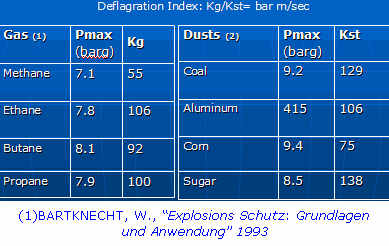
Combustible dusts have similar explosion severity (Pmax, Kst) effects as flammable liquids, gases, and vapors concerning destructive overpressure, thermal radiation, and ensuing projectiles. Facilities that maintain processes with over 10,000 pounds of flammable liquids and gases must consider these products as highly hazardous chemicals (HHC) as outlined in the OSHA's Process Safety Management regulation (29 CFR 1910.119). So if combustible dusts have similar devastating explosive effects causing fatalities and catastrophes (FAT/CAT) like flammable liquids and gases, why aren't they listed as a highly hazardous chemicals(HHC)?

Wood, food, textiles, paper and many other seemingly harmless materials in manufacturing process streams are not considered toxic, reactive, or corrosive like the over 130 highly hazardous chemicals (1910.119 App A) under the Process Safety Management program. It's their combustible and explosive characteristics that need to be addressed as it is for flammable liquids and gases HHC (highly hazardous chemicals) in the OSHA PSM standards.

Recognizing the hazards of combustible dust is the first step through a process hazard analysis which is the foundation in lessening the occurrence and reducing the severity of future combustible dust related fires and explosions. Once the hazards are identified and evaluated control measures can be implemented in similar fashion as outlined in the OSHA Process Safety Management program. A few of the measures in the current PSM with debatable input to a possible Combustible Dust PSM include:

Operating Procedures
For instance, the implementation written operating procedures addressing operating limits with consequences of deviation with steps to follow to correct deviations such as high operating temperatures. These operating procedures must include safety and health considerations
concerning quality control for raw materials and control of dust emissions. Additionally, precautions necessary to prevent combustible dust related fires and explosions, which also includes engineering controls, administrative controls, and personal protective equipment.

Contractor Participation
A process safety management program would also require contractor participlation. Over the past year a large percentage of combustible dust related fires have involved contractors conducting hot work adjacent to process equipment. A Combustible Dust PSM would properly and proactively inform contract employers of the known potential combustible dust fire, explosion hazards related to the contractor’s work and the process. This would lessen the occurrence of future incidents.

Mechanical Integrity (MI)
Mechanical integrity (MI) issues in a Combustible Dust PSM, would address the potential ignition sources that cause combustible dust related fires and explosions at facilities. For instance duct work, dust collectors, dryers, mixers, blenders, ovens, bulk storage enclosures are reoccurring problem areas concerning combustible dust related fires and explosions.

The refinery sector Mechanical Integrity PSM program addresses pressure vessels and storage tanks, piping, relief and vent systems and devices, and emergency shutdown systems controls. In contrast the manufacturing sector has bulk storage enclosures (silos, bins), pneumatic conveying duct systems, air material separators (dust collectors), in addition to relief and venting with explosion ventilation panels in reducing the severity of dust explosions.

Implementing written procedures to maintain the integrity of the above process equipment would provide employees with an overview of the mechanical integrity process and the combustible dust hazards that have been identified in a prior process hazard analysis. Process equipment inspection, maintenance, and testing would also be a vital aspect in the MI at the facility where deficiencies can be addressed in a proactive manner.

Incident Investigation
Reoccurring incidents of combustible dust related fires and explosions have been a common theme in the manufacturing sector over the past year. This year, over 30% of incidents are repeats of prior fires and explosions at facilities. In many instance a combustible dust fire is a precursor to a a rare event, the combustible dust explosion.

Without proper incident investigation by the facility, the exact cause of the fire goes unnoticed and the combustilbe dust hazard remains present for the next preventable and predictable incident. A Combustible Dust PSM would identify the chain of events and causes where corrective measures
such as Recognized And Generally Accepted Good Engineering Practices (RAGAGEP) can be developed and appropriately implemented.

Conclusion:
Do I feel lucky?
The above examples are just a few proactive measures that could be crucial aspects of a Combustible Dust PSM that is similar to the current PSM utilized for facilities which process highly hazardous chemicals (HHC). Other measures in the PSM include Hot Work Permits, Emergency Planning and Response, Management of Change, and Compliance Audits. Many of the areas are already covered in the National Fire Protections Association (NFPA) combustible dust standards.

Until combustible dusts are recognized as having similar explosive severity characteristics as flammable liquids and gases (highly hazardous chemicals) of the current OSHA PSM, preventable and predictable combustible dust related fires and explosions will continue to occur. Hopefully on a bit of borrowed time the next rare event will not be in the magnitude of the recent Imperial Sugar Refinery dust explosion. Like
in the 1971 Dirty Harry movie, Detective Inspector Harry Callahan played by Clint Eastwood asks, "You've got to ask yourself one question: 'Do I feel lucky?"


Questions, Problems, Feedback? Please send email by clicking this link...Thanks

©Copyright 2008-2012. Combustible Dust Policy Institute
The information in http://dustexplosions.blogspot.com/ is not meant to be a substitute for the Code of Federal Regulations (CFR), Federal Register, and other OSHA documents, which should serve as the primary source of regulatory guidance. The information on this site should not be used in place of appropriate technical or legal advice related to your company's specific circumstances. Combustible Dust Policy Institute tries to provide quality information, but we make no claims, promises or guarantees about the accuracy, completeness, or adequacy of the information contained in or linked to this web site and its associated sites. Combustible Dust Policy Institute has no liability arising from or relating to the use, interpretation, or application of the information or its accuracy or inaccuracy. Copyright notice: All materials in this site are copyrighted by the Combustible Dust Policy Institute. No materials may be directly or indirectly published, posted to Internet and intranet distribution channels, broadcast, rewritten for broadcast or publication or redistributed in any medium without permission.