Recent firefighter injuries such as fighting a combustible dust related
fire at plastics material and resin manufacturing are unacceptable. This
brings back dark memories of the 1993 fire and catastrophic dust
explosion at a wood fiber facility in Langerak, Netherlands resulting in
2 firefighter fatalities and 10 firefighter injuries.
A question arises whether firefighters should be afforded the same
workplace protection as workers in the private sector noted in the OSHA regulations?
State and local government agencies such as the Monroe Fire
Department are not subject to the regulations established by Federal
OSHA. For
instance, Section 3(5) of the Occupational Safety and Health Act of
1970 (the Act) specifically excludes the employees of State and local
government from coverage under Federal OSHA. This does present a huge problem where a failure to assess and
identity combustible dust fire and explosion hazards can have severe
consequences.
“While attempting to extinguish the fire, Centers said “there was a dust
explosion” that caused the three injuries. He said firefighters were
attempting to remove the material, which was through a 2-1/2-inch pipe
at the bottom of the tank. “Dust that was created while they were
pulling the dry material out found an ignition source and ignited,” he
said.” Bridging and Rat-holing come to mind? What do you think?
In contrast, the OSHA
General Duty Clause is applicable to practically
any fire-fighting operation where combustible dust fire and explosion
hazards are present. Fire Departments are required to identify the
combustible dust hazards that firefighters may be exposed to. This can
be implemented by providing firefighters the necessary standard
operating procedures, combustible dust training, and equipment to safely
mitigate the hazard.
The OSH Act is not all inclusive of the 26 States currently authorized
by OSHA to run their own safety and health programs (OSHA State-Plan
states), enforcing OSHA regulations that apply to both public and
private employees in state-plan states.
Additionally, “NFPA recommends that all fire departments establish a
policy of providing and operating with "the highest possible levels of
safety and health for all members" [NFPA 1992]. Several NFPA standards apply to fire-fighting operations such as NFPA 1500 specifying the
minimum requirements for a fire department's occupational safety and
health program.
Typical Fire with Combustible Dust?
Questions arise in whether fire departments do have the necessary
training in understanding combustible dust fire and explosion hazards
while combating combustible dust related fires? For example, in a recent
news report a fire chief mentioned the fire at the plastics material
and resin manufacturing
“was typical of all fires”
(01:20) video.
Since when is a combustible dust related fire typical? Especially when
it has the explosive severity and severity of consequence of a flammable
gas or vapor?
This post is in no way is meant to discredit the fire service, fire
chief’s, and brave firefighters risking their lives everyday protecting
life and property. It is solely to bring the subject to the table where
the fire service must be welcomed to join in the current
OSHA
Combustible Dust Rulemaking process which must also include education,
outreach, and training for all stakeholders and not just a select few. At the 2011 OSHA
Combustible Dust Expert Forum held in Washington, D.C. not one
member from the fire service was invited.
"Houston, we've had a problem".
Learning from Prior Incidents
Similar
incident Feb. 2012 at Advanced Environmental Recycling Technologies
(AERT), no one was injured in the blast. Dust explosion at Arkansas
facility that recycles polyethylene plastic and waste wood fiber in the
manufacturing of windows, doors, and decking. AERT wood composite MSDS
Responding to any combustible dust related fire is not a "typical fire."
All that is needed to complete the explosion pentagon (fire triangle on
steroids) is suspension and confinement. Dust suspension alone can also
occur. When extinguishing this type of Class A fire, extreme care needs
to be taken. For example, since a direct stream of water into the pile from a fire
hose could cause the burning or smoldering material to become airborne
resulting in a catastrophic flash fire or even spreading the fire to
other areas. Source: Handbook of Industrial Loss Prevention, 1967,
Factory Mutual Engineering Corporation, McGraw-Hill Book Company New
York, NY.
In Langerak, Netherlands (1993) "firefighters responded to a small fire
in a wood fiber processing plant where unexpectedly an explosive spread
of fire occurred. As a result, eventually three persons, including two
firefighters, deceased and fourteen individuals, most of them
firefighters were injured. The fire from the beginning was initially
believed to be a fire without special risks."
Theres a wealth of scientific and layman literature on the
physicochemical properties on combustible dust. The missing link is the
practical aspects and hazards of combating a combustible dust related
fire,. Such as the example above in caution using a hard stream of water
from a hose or a avoiding pressured burst from a fire extinguisher.
Then there is the bridging (arching) and ratholing hazards in overhaul
of bulk storage enclosures (silios, bins, etc). The list goes on in
practical aspects...
Near-Miss Accident Reporting
Reviewing lessons-learned from ComDust incidents on the National Fire Fighter Near-Miss Reporting System site it appears many in fire service
management believe the primary consideration is PPE. How about
lessons-learned in preventing envelopment by a raging fireball in the
first place?
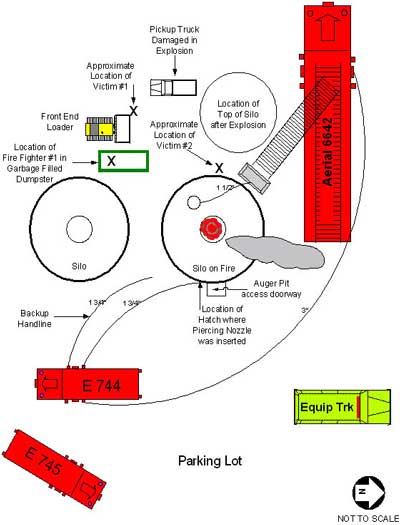
Dec. 21, 2007 "The lieutenant reported that workers were on the scene
and that the fire "appeared to be extinguished". The lieutenant and a
firefighter stretched a 1 3/4" attack line to an elevated platform
approximately 15' from the ground to a hatch on the side of the silo.
Once the line was charged the lieutenant opened the hatch and
immediately heard a loud roaring sound followed by a flash fire erupting
form the hatch opening engulfing the lieutenant."
Hold on the story gets even more interesting...
"The second engine arrived and was given the suppression assignment. The
charged hoseline from the first engine was still in place so they
utilized it. The second crew was not aware of the events that had taken
place, only that the lieutenant was down. Once on the landing, the
second lieutenant opened the hatch and again a loud roaring noise
followed by a flash fire and explosion occurred engulfing the second
Lieutenant and firefighter." Years of fire service experience: 24 - 26, Region: FEMA Region III
We cannot continue to ignore the combustible dust related fires anymore.
How
many more firefighter fatalities and injuries as a result of
combating combustible dust related fires and explosions must occur
before it is no longer acceptable?
Resources:
One
Firefighter Fatality; Eight Injured WI, NIOSH Accident Report
Seven
Firefighters Injured CA Facility, NIOSH Accident Report
Example
Fire Department Training Program Compliance with OSHA Regs.
OSHA
Combustible Dust Expert Forum, Washington, D.C, (2011)
Composite and PVC Decking




 RSS Feed Subscribe